

In short
- Voice provides a consistent writing personality; tone responds to context.
- Microsoft describes a steady voice with adaptable tone.
- Atlassian changes tone for situations such as errors and successful completion.
In this article
The difference between brand voice and tone is consistency versus context: voice is your ongoing writing personality, while tone is how you express it in a particular situation. Mailchimp makes this distinction in its public style guide.1 A clear, helpful voice can sound celebratory in an announcement and serious in an apology.
What stays the same, and what changes?
Keep your voice traits steady across ordinary communication. Adjust the emotional intensity and formality to fit what the reader needs. Microsoft's guide explicitly describes a constant voice with tone adapted to the situation.2 Nielsen Norman Group defines the tone side plainly: tone of voice is how you tell readers how you feel about your message, and it is the way you communicate your personality.3
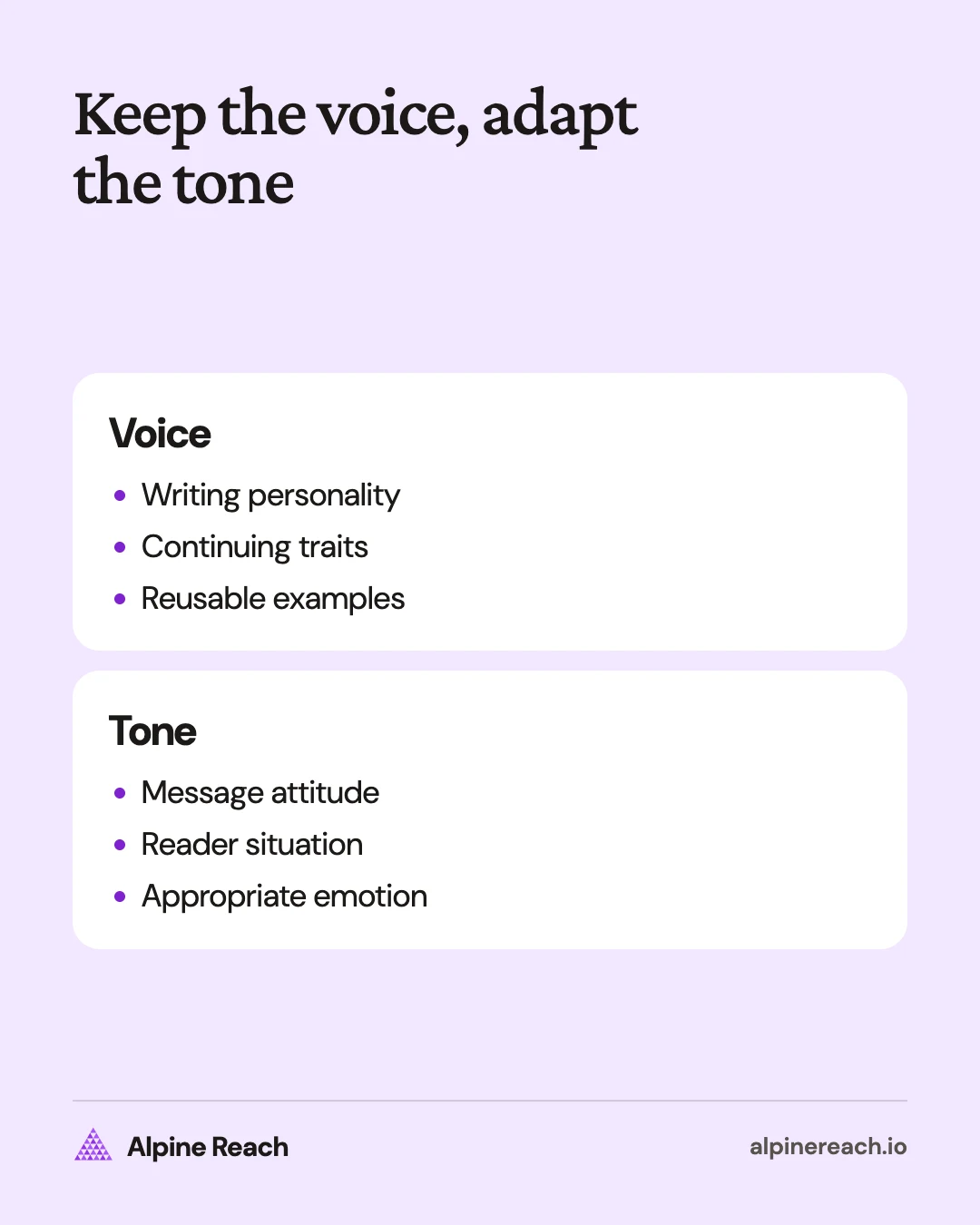
Use voice rules to decide how your writing behaves. For a freelance business, those rules might be: name the action, explain unfamiliar terms, and acknowledge limits. Use a tone brief to decide how much excitement, humor, or caution belongs in today's message.
| Question | Brand voice | Tone |
|---|---|---|
| What does it describe? | The continuing personality of the writing | The attitude of this message |
| What guides it? | Your chosen traits and writing examples | The reader's situation and the subject |
| What might it include? | Plain words, specific advice, candid explanations | Celebration, restraint, reassurance, urgency |
| What should a writer save? | A voice chart with approved examples | Examples for recurring situations |
| How do you review it? | Does this sound like the same business? | Is this appropriate for what is happening? |
The table is a practical application of the distinction, not a rule that every organization uses the same labels. When a brief says “tone of voice,” check whether it means the overall personality, the mood of a message, or both.
Tone changes are noticeable. In a Nielsen Norman Group survey of 50 American respondents, paired samples that differed only in tone were rated differently on friendliness and formality. The differences were statistically significant but small, about 0.5 to 1 point on a 5-point scale.3
How do style and message fit into the distinction?
For your own editing process, separate personality from the information and mechanics. A message is what the reader needs to know. Style rules are choices such as spelling, capitalization, punctuation, and how you write dates. Voice and tone guide how you express the information within those rules.
Take this announcement: “The workshop starts Tuesday at noon ET. Bring your draft.”
- The message is the schedule and what to bring.
- The voice is direct and practical.
- The tone is matter-of-fact.
- The style includes the time-zone abbreviation and short sentences.
“Great news! The workshop starts Tuesday at noon ET. Bring your draft” changes the energy without changing the schedule. Moving the workshop to Wednesday changes the message, even if every sentence still sounds like you.
Keep this distinction useful rather than technical. If an editor says a draft is “off voice,” ask which sentence creates the mismatch and what a better version would say. That gives you something to revise.
The same voice in three different situations
Say you run a small online workshop business. Its voice is clear, considerate, and practical. The following examples are invented to demonstrate how those traits can remain while the tone changes.
A launch: upbeat and inviting
Post: “The project brief workshop is open for registration. Bring the draft you're working on, and we'll help you make the next step clearer. See the session details before you sign up.”
The tone welcomes the reader. The voice remains practical because it names the activity and the next action. Before publishing, verify what the workshop actually includes.
An unsuitable version would add excitement without information: “Something incredible is coming. You won't want to miss this!” The problem is the lack of a concrete message, not enthusiasm itself.
A cancellation: serious and accountable
Post: “We're sorry, Tuesday's project brief workshop is canceled. We'll email registered attendees today with refund details. Please check the address you used to book.”
The same voice now removes celebration and leads with the disruption. The next step is specific. Use a time commitment only when the team has confirmed it.
“Tiny schedule surprise!” would ask the reader to share your lighthearted attitude about an inconvenience. Choose wording that acknowledges the situation from their perspective.
A beginner question: patient and explanatory
Reply: “A project brief is a short description of what you're making, who it's for, and what it needs to do. Start with those points. You can add delivery details once the goal is clear.”
The voice still favors concrete language and useful action. The tone becomes patient because the reader needs an explanation, not a promotion.
There is no need to open with “Obviously” or “As everyone knows.” Those phrases add an assumption about the reader's knowledge without helping them complete the task.
Atlassian's public app-content guidelines also tie tone changes to the user's situation, contrasting errors with successful completion.4 That supports adapting your delivery while retaining a recognizable personality.
Write a voice rule and a tone rule separately
Use this original mini-template when briefing yourself or another writer. The voice section can stay in the shared guide; the tone section belongs with the post.
Voice rule: “We explain decisions in plain language, acknowledge limitations, and give the reader a useful next action.”
Tone for this post: “Restrained and considerate. The reader has been inconvenienced. Lead with the change and the remedy. Leave out jokes.”
Facts that must stay: “Which session is affected, whether it is canceled or rescheduled, what happens to bookings, and where to ask a question.”
Review question: “Can the reader understand what happened and what to do without interpreting our mood?”
Add an approved example and a rejected example with a reason. Avoid building a huge adjective list with no sentences attached. If your rules include “friendly,” show how friendliness works in a correction as well as an invitation.
Use the brand voice guide and chart to build the reusable section. Use the tone examples to choose wording for a particular moment.
Fix inconsistency at the sentence level
When two posts sound unrelated, inspect the choices that changed. One might use unexplained specialist terms, another exaggerated excitement, and another a stiff company announcement. Choose the mismatch that interferes with your voice rule and revise it.
Keep useful differences. A tutorial needs more explanation than a short availability update. A founder's personal reflection can use “I,” while a company announcement uses “we.” Consistency does not require identical openings, paragraph lengths, or endings.
If AI is helping with drafts, include both the shared voice rule and the current tone brief. Mark the facts the draft must preserve and review the result against them. The AI content workflow shows how to combine those instructions with editing and source checks.
Revisit the voice guide when your business deliberately changes its audience or positioning. Make that an explicit editorial decision. A different mood for one post should not silently rewrite the personality of the whole account.
FAQ
Is being professional a voice or a tone?
Define what you mean in the brief. You might use it as a continuing voice trait or as a request for more formal wording in a specific message. Add an example either way.
Do I need separate guidelines for every platform?
Start with one voice guide and add examples for the formats you use. Write a separate tone note when the reader's situation calls for a different level of formality or emotion.
Should I change my voice if a draft feels stale?
First revise the specific sentences, examples, or repeated openings. Change the shared voice rules when you deliberately want the business to communicate differently.
General information. Platform features, limits and benchmarks change: check the cited page before you rely on a number.
References
- Mailchimp. Voice and Tone. n.d. View source (accessed Nov 10, 2026).
- Microsoft. Microsoft's brand voice: Above all, simple and human. 2022. View source (accessed Nov 10, 2026).
- Nielsen Norman Group. The Four Dimensions of Tone of Voice. 2016 (reviewed 2023). View source (accessed Nov 10, 2026).
- Atlassian. Voice and tone. n.d. View source (accessed Nov 10, 2026).