

In short
- Voice combines personality, substance, tone, and style.
- A steady voice can adapt its tone to the reader's emotional state.
- Microsoft emphasizes warmth, clarity, and helpfulness.
In this article
Brand voice is the recognizable personality in your writing: the words, rhythm, and attitude you keep across posts and replies. Microsoft describes voice as a mix of personality, substance, tone, and style.1 To define yours, choose a few traits and show what each means in an actual sentence.
What is brand voice, and how is it different from tone?
Your voice provides continuity; your tone responds to the moment. Mailchimp explains that its voice stays relatively steady while its tone changes with the reader's emotional state.2 A friendly business can sound excited about a launch and careful about a delayed order without becoming a different business. See brand voice vs tone for a fuller comparison.
Writing your voice down also makes it transferable. With the rules on paper, a collaborator, a freelancer, or an AI tool can produce a draft you only need to edit, not one you need to rewrite.
Treat voice as a set of writing decisions you can check. Do you say “use” or “utilize”? Do you explain your reasoning? Are jokes welcome, and what subjects are off limits? Those decisions make “friendly and professional” specific enough for someone else to apply.
For a solo creator, start with language you already use when explaining your work clearly. For a team, agree on the shared voice for the business account. A founder's personal account can have its own habits without making every company reply sound like that person.
How do you define your brand voice?
Start with your audience and your existing writing, then choose three or four traits. Use the process below as a working exercise, not a scoring system.
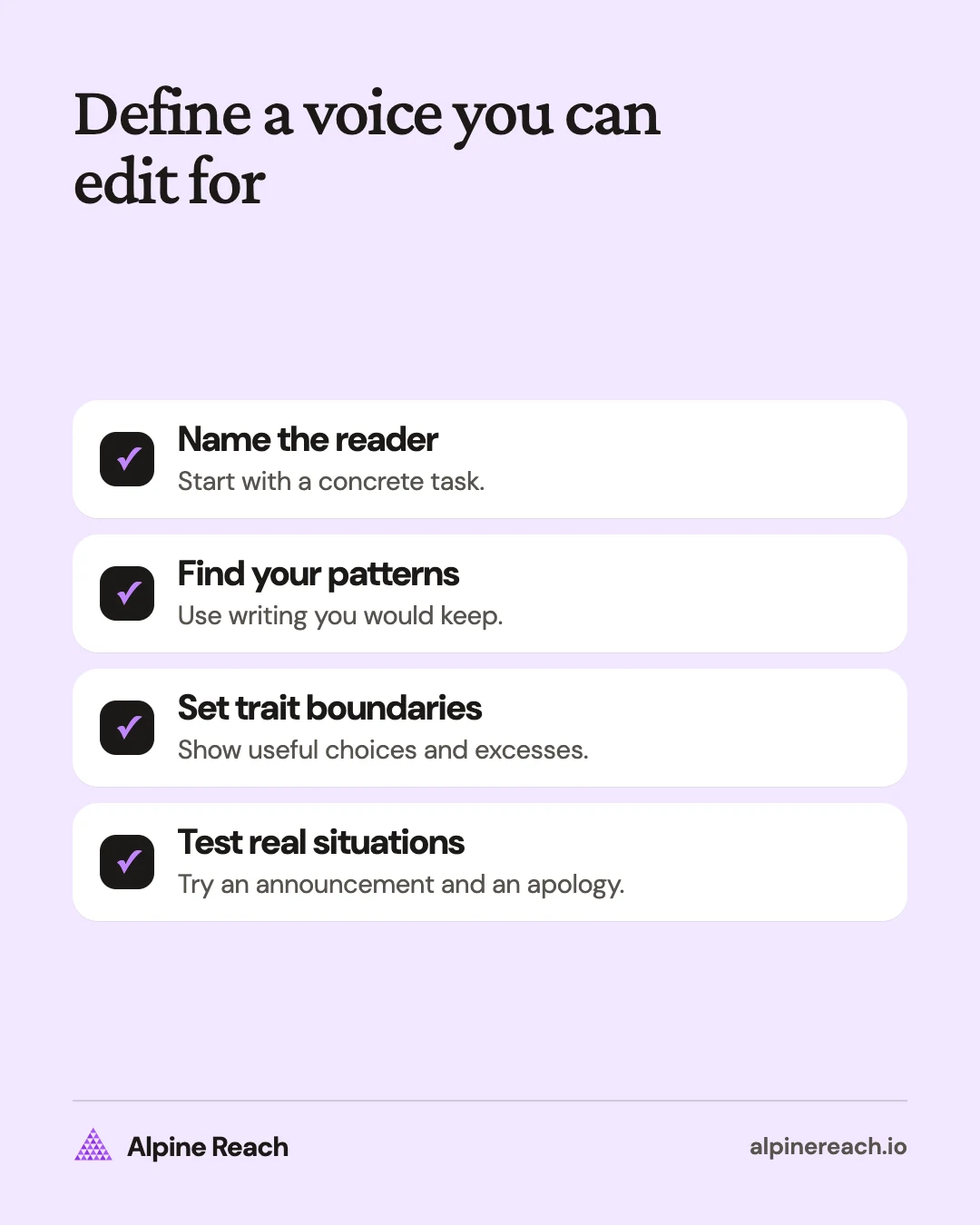
- Name the reader and their task. “Freelancers preparing their first project estimate” gives you more direction than “ambitious professionals.” Write down what they know and what they need explained. Add one line about what you stand for, such as “we explain our pricing up front.” Traits are easier to apply when they come from a commitment.
- Collect writing you would keep. Gather posts, explanations, or replies you wrote and still like. Remove material you would not want a new writer to imitate.
- Mark observable patterns. Look for everyday vocabulary, short openings, concrete examples, opinions you can defend, and how you acknowledge uncertainty.
- Choose traits with boundaries. Give each trait a positive instruction, an excess to avoid, and a sample line.
- Try the rules on different situations. Write an announcement, a tutorial, and an apology. If the same rules cannot support all of them, revise the rules.
Say you are a freelance designer who wants to sound clear, warm, and practical. “Clear” means naming the next action. “Warm” means acknowledging the reader's concern. “Practical” means explaining what to do with the advice.
Avoid choosing an adjective because a larger brand uses it. Ask whether you can point to the trait in your own writing and whether it helps the intended reader. If “bold” means making claims you cannot support, choose a different rule.
Brand voice examples from public guidelines
These examples describe what each organization says about its own writing. The practice rewrites under them are ours.
Microsoft: approachable and useful
Microsoft's public guide emphasizes warmth, clarity, and helping the reader act.1 For your own guidelines, translate that kind of direction into something observable: put the next step near the beginning and replace abstract business language with a concrete verb.
Practice rewrite: “Implementation of the configuration is advised” becomes “Open Settings and choose your time zone.”
Mailchimp: plain language with restrained humor
Mailchimp describes its voice as plainspoken, genuine, able to explain difficult subjects, and dry in its humor.2 The useful lesson is to define both the personality and its boundaries. A joke should not make an instruction harder to understand.
Practice rewrite: “Optimize your audience segmentation methodology” becomes “Group readers by what they signed up to hear about.”
Atlassian: practical with room for personality
Atlassian's public UI and app guidelines describe a voice that is bold, optimistic, and practical with a wink; the page separates that guidance from its internal marketing guidelines.3 Borrow the discipline of defining when personality belongs, rather than copying the brand's vocabulary.
For a workshop account, “Your worksheet is ready. Bring your questions” can express confidence without adding a slogan. A cancellation notice would need a more careful tone. The underlying commitment to useful information can remain.
Copy this brand voice chart template
Use a chart that connects each trait to an editing choice. The filled example below is for a freelance design business.
| Voice trait | Do this | Avoid this | Sample line |
|---|---|---|---|
| Clear | Name the action and the object | Replace specifics with business jargon | “Send your logo files before we start.” |
| Warm | Acknowledge a real concern | Add forced familiarity or pet names | “If you're unsure which file to send, ask.” |
| Practical | Explain the next useful step | End with an abstract slogan | “Start with the page your customers visit first.” |
| Candid | State what is known and unknown | Overstate certainty to sound confident | “We can estimate the timeline after we review the brief.” |
For a blank version, use these fields:
- Audience and task: Who is reading, and what do they need?
- Trait: The quality you want the writing to express.
- This, not that: The useful behavior and the excess to avoid.
- Approved example: A sentence you would publish.
- Revision example: A sentence you would change, with the reason.
Add a short vocabulary list below the chart. Include words your audience uses, technical terms that need an explanation, and phrases you would never naturally say. Keep spelling and punctuation preferences nearby, but separate them from personality traits.
If the chart could describe any business in your field, make the examples more specific. A rule such as “name the deliverable before describing its benefits” gives an editor a decision to make.
Apply the voice without repeating yourself
Keep the traits steady and adapt the level of energy, detail, and formality to the reader's situation. Work through the tone of voice examples before writing a sensitive reply or adapting an announcement for another platform.
For a routine review, hide the account name and read the post aloud. Mark anything you would never say. Check that the first line makes a concrete point and that the closing asks for an action you actually want. If another writer is involved, compare your edits and add the useful decisions to the chart.
When using AI, give it approved writing samples and the chart as drafting instructions. Keep the final editorial decision with a person. The AI content workflow covers editing and fact checking, while the ChatGPT prompts provide starting instructions for specific tasks.
Review the guide when your audience, offer, or point of view changes. Update it with a before-and-after example and a reason. You do not need a new personality for every post, but you do need rules that describe the writing you want today.
FAQ
Can a solo creator have a brand voice?
Yes. Start with writing you already stand behind, then record the language choices you want to repeat. Your chart can be short and still guide future posts.
What if every trait sounds generic?
Add a sentence you would publish and one you would revise. Explain the difference. Keep a trait only if it changes an actual editing decision.
Should a founder and the company sound identical?
Decide how closely the accounts should relate. You can share values and vocabulary while giving the founder room for a personal point of view.
General information. Platform features, limits and benchmarks change: check the cited page before you rely on a number.
References
- Microsoft. Microsoft's brand voice: Above all, simple and human. 2022. View source (accessed Nov 10, 2026).
- Mailchimp. Voice and Tone. n.d. View source (accessed Nov 10, 2026).
- Atlassian. Voice and tone. n.d. View source (accessed Nov 10, 2026).