
In short
- Tone can vary across humor, formality, respectfulness, and enthusiasm.
- Tone labels can help you plan and evaluate your content.
- Adapt your tone to context and the reader's state of mind.
In this article
Tone of voice is the attitude your words convey in a particular message. For social media, you can keep the information fixed while making the wording more formal, casual, serious, or enthusiastic, dimensions described by Nielsen Norman Group.1 Choose the version that fits the reader's situation and your established voice.
Use the four tone dimensions to choose a direction
Nielsen Norman Group's framework describes four dimensions: humor, formality, respectfulness, and enthusiasm.1 Treat each as a range, rather than a box that every post must fit.
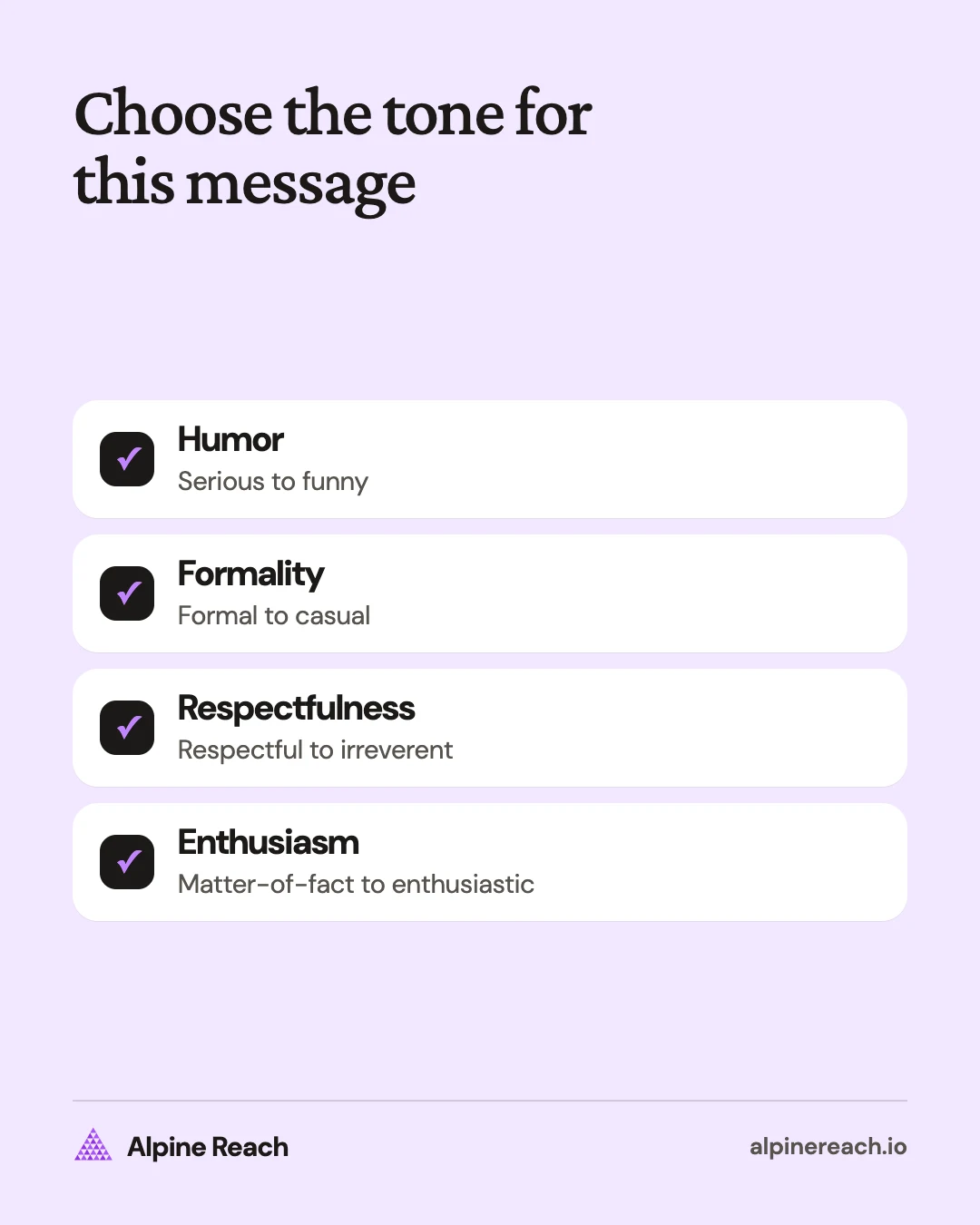
| Dimension | One end | Other end | Editing question |
|---|---|---|---|
| Humor | Serious | Funny | Is a joke appropriate here? |
| Formality | Formal | Casual | How conversational should the wording be? |
| Respectfulness | Respectful | Irreverent | Can you question the convention without insulting the reader? |
| Enthusiasm | Matter-of-fact | Enthusiastic | How much excitement belongs in this message? |
You can be casual and serious at the same time. “We're sorry your order is late” uses everyday language without trying to entertain. You can also be formal and enthusiastic: “We are pleased to announce that registration is open.”
Use familiar labels to describe the overall result. Nielsen Norman Group's separate tone-word guide includes words such as conversational, informative, playful, and sympathetic for planning and evaluating content.2 These labels help you brief a writer, but they still need a concrete example.
The full list has 37 words, including authoritative, caring, cheerful, friendly, humorous, professional, trustworthy, and witty.2 Pick two or three for a message and name one to avoid, such as “sympathetic, not cheerful.”
For the distinction between a consistent personality and the attitude of a particular message, read brand voice vs tone.
Tone changes are noticeable. In a Nielsen Norman Group survey of 50 American respondents, paired samples that differed only in tone were rated differently on friendliness and formality. The differences were statistically significant but small, about 0.5 to 1 point on a 5-point scale.1
Twelve before-and-after tone examples
Within each pair below, the information stays the same and only the tone changes. The second version is not automatically the better choice.
1. Formal to conversational
Before: “Registration for the workshop is now available.”
After: “You can sign up for the workshop now.”
The rewrite speaks directly to the reader. Use it when you want an invitation to sound like something you would say aloud.
2. Matter-of-fact to enthusiastic
Before: “The workshop workbook is available.”
After: “The workshop workbook is here! Take a look.”
The facts stay unchanged. The exclamation mark and invitation add energy without claiming a benefit the workbook has not demonstrated.
3. Casual to formal
Before: “We're closing early on Friday.”
After: “Our office will close early on Friday.”
The second version reduces the conversational feel. Neither version is complete enough to publish until you add the actual closing time.
4. Promotional to informative
Before: “Don't miss our new guide to writing a project brief!”
After: “Our new guide explains how to write a project brief.”
The revision describes the resource instead of telling readers how to feel about it. Try it when the subject itself is useful enough to lead.
5. Flat to warm
Before: “Your question has been received. We will reply tomorrow.”
After: “Thanks for your question. We'll reply tomorrow.”
A short acknowledgment adds warmth without inventing a relationship. Only keep the promised reply date if you can honor it.
6. Cheerful to considerate
Before: “Quick update! The workshop has been canceled. Refunds are on the way!”
After: “We're sorry the workshop has been canceled. Refunds are on the way.”
The important information stays. The revision removes a celebratory opening that does not fit disappointing news.
7. Blunt to supportive
Before: “You need to add image descriptions before publishing.”
After: “Before you publish, add image descriptions to help explain the visuals.”
The instruction stays direct, and the reason makes it easier to understand. A supportive tone can still tell someone exactly what to do.
8. Serious to lightly playful
Before: “Our behind-the-scenes post shows how we organize project files.”
After: “A small victory over folder chaos: here's how we organize project files.”
The humor concerns the task, not the reader. Skip it if the main information gets lost or the phrase does not sound like you.
9. Conversational to concise
Before: “The live session starts at noon ET on Tuesday. Come along.”
After: “Join the live session on Tuesday at 12 p.m. ET.”
The rewrite puts the invitation and schedule in one short line. Use it when readers scan for the time more than the tone.
10. Detached to empathetic
Before: “Your delivery is delayed. The tracking link is in your email.”
After: “We're sorry the delay is causing inconvenience. You'll find the tracking link in your email.”
The revision adds an apology while preserving the available next step. Check the actual delivery information before posting either version.
11. Commanding to collaborative
Before: “Choose the next tutorial topic: lighting or editing.”
After: “What would help you next: a tutorial on lighting or editing?”
Both offer the same choice. The second asks about the reader's need instead of presenting the decision as an instruction.
12. Respectful to mildly irreverent
Before: “A polished desk isn't necessary for planning your next post.”
After: “The perfect desk can wait. You can plan your next post without it.”
The rewrite questions a convention without criticizing people who enjoy tidy workspaces. Keep irreverence aimed at the idea you are questioning.
Adapt the tone by platform and situation
Use platform as a format choice, then adjust for the actual audience and event. Microsoft explicitly describes adapting tone to context and the reader's state of mind.3 The examples below are editorial options, not platform requirements or ranking advice.
| Situation | Instagram option | LinkedIn option | Short video option |
|---|---|---|---|
| New tutorial | Lead with the visible task: “Here's how to label your files.” | Lead with the work problem: “Unclear file names slow down handoffs.” | Say the problem, then demonstrate the fix. |
| Behind the scenes | Pair a casual explanation with the image. | Explain the decision behind the process. | Use spoken language you can deliver naturally. |
| Delay or mistake | State what happened and what readers should do. | State the same facts with the relevant work context. | Keep the explanation plain and remove comic effects. |
A professional topic does not require corporate jargon. A short video does not require slang. Write for the people you expect to reach and the information they need at that moment.
For caption structure, use the Instagram caption guide. For a work-related argument, start with how to write a LinkedIn post.
Check what the message actually communicates
Read your draft once for information and once for attitude. Confirm the dates, action, and relevant limitation first. Then underline words that create urgency, excitement, blame, or familiarity.
Ask a reader to describe the tone without showing them your intended label. If you wanted “reassuring” and they read “dismissive,” revise the wording. Look at the specific phrase they identify, rather than arguing over the adjective.
Keep the same factual message when comparing versions. If one draft adds a discount and the other does not, you are comparing offers as well as tone. For a simple editorial check, change the opening or level of formality while keeping the action and information steady.
Save the examples that fit your account in a brand voice chart. A useful tone note says where the example belongs: a routine reply, a launch announcement, or a correction. That makes the choice easier the next time you write.
FAQ
How do I make a post friendly without adding slang?
Address the reader directly, use familiar words, and acknowledge their actual question. Try a short, natural sentence before adding slang or extra punctuation.
Can I use humor in every post?
Treat humor as a choice for the situation. For a delay, cancellation, or complaint, start with the facts and a useful response rather than a joke.
Which version should I choose from a before-and-after example?
Choose the version that fits your voice and the reader's situation. The second version demonstrates a change in tone, not a universal improvement.
General information. Platform features, limits and benchmarks change: check the cited page before you rely on a number.
References
- Nielsen Norman Group. The Four Dimensions of Tone of Voice. 2016 (reviewed 2023). View source (accessed Nov 10, 2026).
- Nielsen Norman Group. Tone-of-Voice Words. 2016 (reviewed 2023). View source (accessed Nov 10, 2026).
- Microsoft. Microsoft's brand voice: Above all, simple and human. 2022. View source (accessed Nov 10, 2026).