
In short
- Buffer suggests testing 3 to 5 weekly feed posts, including Reels.
- Its frequency study combines photos, carousels, and Reels and excludes Stories.
- Instagram says its fastest-growing creators post 10 or more Reels a month on average.
In this article
- What Instagram itself has said about frequency
- What the studies can and cannot tell you
- Count feed posts and Reels together, Stories separately
- Choose a cadence using your actual production time
- Increase or reduce frequency using comparable evidence
- Keep Instagram inside the broader content plan
- FAQ
- References
Start by testing 3 to 5 feed posts per week, counting photos, carousels, and Reels together. That range comes from Buffer's study, not a universal Instagram requirement. 1 Divide the work between formats you can make useful, and plan Stories separately around updates worth sharing.
What Instagram itself has said about frequency
Meta's October 2024 Best Practices announcement says its Creation section covers how often to post and includes personalized tips in the professional dashboard. The announcement does not give everyone a fixed weekly quota. 2
Instagram's creator FAQ is the one place it gives a number. It says posting frequency is one factor of many, and that creators with the greatest net follower growth post, on average, 10 or more Reels per month. That is an average among already fast-growing accounts, not a rule that 10 Reels will grow yours.3
That distinction matters when you encounter a supposedly official daily schedule. Check whether the number is an account-specific recommendation, a publisher's analysis, or an individual creator's opinion. They can all inform a plan, but they are different kinds of evidence.
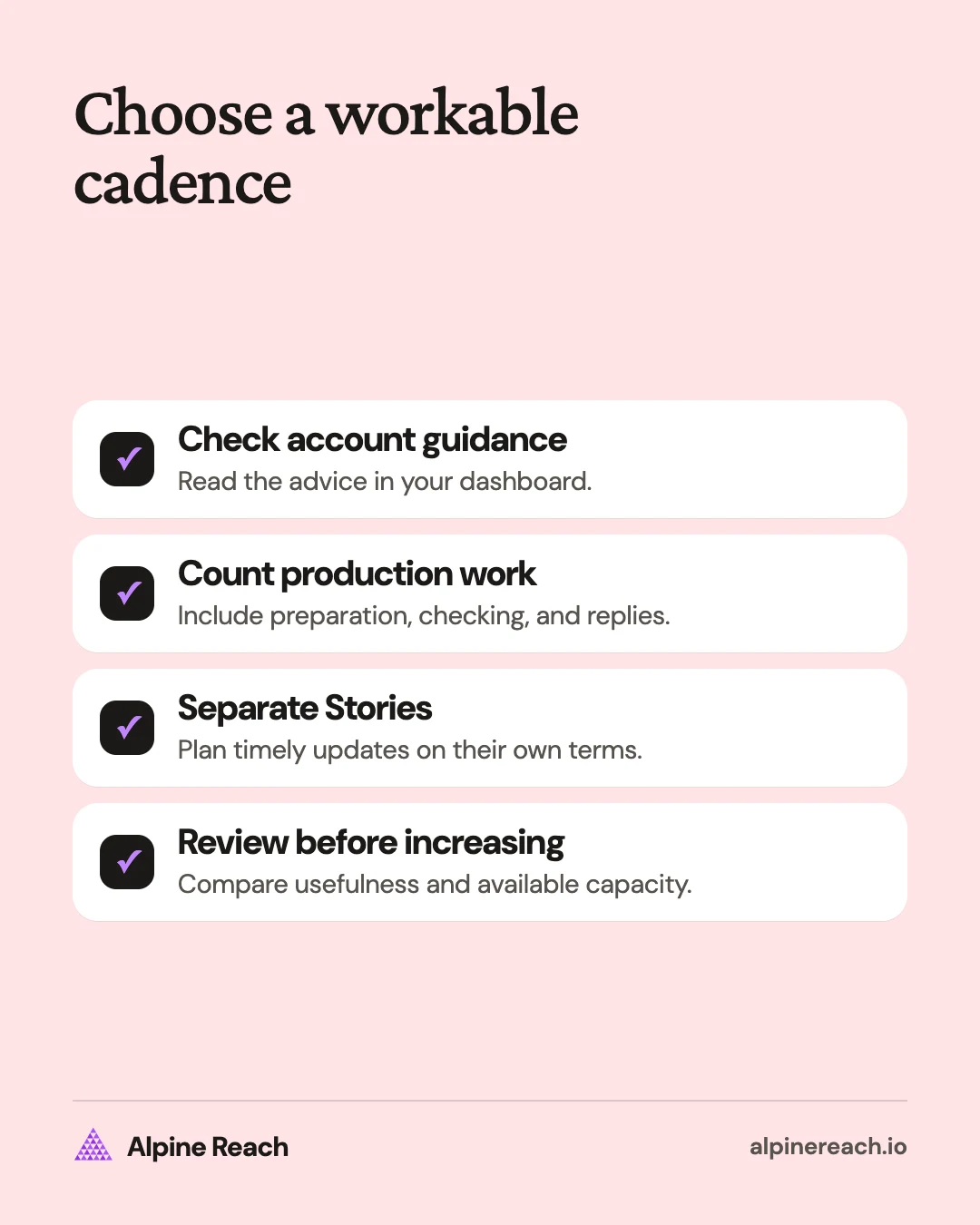
Start with the guidance available in your own dashboard, then fit it to your capacity. If a recommended cadence means rushing demonstrations or repeating an offer without new information, reduce the workload until each post has a clear purpose.
You do not need to turn a missed post into an emergency. Rebuild the next useful piece, then return to a schedule you can maintain.
What the studies can and cannot tell you
Buffer's page is dated August 13, 2025, despite its 2026 headline. Its analysis covers 2.1 million posts from 102,000 accounts, combines photos, carousels, and Reels, and excludes Stories. It identifies 3 to 5 weekly posts as a practical starting range, with diminishing returns at higher volumes. 1
Buffer found that posting more than five times a week still added reach and followers, with smaller gains per extra post, and called 1 to 2 posts a week the minimum.1
The combined sample cannot establish separate ideal quotas for Reels and carousels. If you want a Reels reference, Instagram's own average of 10 or more a month among fast-growing creators is about two to three a week, and it fits inside a 3 to 5 weekly total. Treat any split you choose as a working plan, then compare what you can produce and what your audience finds useful.
A newer study also shows why activity and effectiveness are separate questions. Metricool's June 16, 2026 report analyzed 24,364,803 posts from 375,118 accounts across January to February in 2025 and 2026. It reported 24.04% more content year over year. That is an observed increase in publishing, not a tested prescription for your account. 4
Neither finding establishes that publishing an extra post will cause a particular result for you. Accounts differ in resources, topics, audience, and production quality. Use the research to select a reasonable experiment, then judge that experiment by your own work and outcomes.
Count feed posts and Reels together, Stories separately
Avoid building a schedule by adding every recommendation you see. If you choose the Buffer starting range, a Reel is part of that total, rather than an extra obligation on top of it. 1
Use the format for what you can explain well:
| Format | What to use it for | How to choose its share of your schedule |
|---|---|---|
| Feed photo | A product detail, finished piece, or clear announcement | Use when the image can explain the subject without a sequence |
| Carousel | Instructions, a comparison, or a decision guide | Allow time to outline, design, and check the whole sequence |
| Reel | A demonstration, movement, or a spoken explanation | Count filming and editing time before promising more videos |
| Stories | A current update, follow-up, or conversation prompt | Publish when there is something timely to share; review separately |
These are editorial uses, not evidence that one format should fill a particular percentage of your calendar. If your work is visual and process-heavy, video may be practical. If your audience needs comparisons, a carousel may explain the subject more efficiently.
For Stories, begin with a short sequence on days when you have a real update or question. You can test daily Stories if you have enough relevant material and capacity, but do not turn the feed-post study into a daily Story quota. Its sample did not include that format. 1
Choose a cadence using your actual production time
List the work behind a finished post: research, scripting, gathering material, filming or design, caption writing, checking, and responding. Include the least visible tasks. A polished clip can look simple while taking more work than the calendar slot suggests.
Then choose a baseline you can maintain during an ordinary busy week. If the research range is too much for your capacity, begin below it and improve the process before increasing volume. A starting benchmark is useful only if it helps you make a workable plan.
Suppose you are a freelance designer with a limited weekly content block. A manageable draft schedule could contain a carousel answering a portfolio question, a Reel demonstrating a layout choice, and a photo explaining a finished self-directed piece. Add a Story follow-up when there is a genuine question to answer. This is an example schedule, not measured performance advice.
Prepare related material together. While filming the layout demonstration, capture the clean final screen you may need for another explanation. Write captions while the context is still fresh. Keep a note of unfinished questions so the next session starts with a subject.
Make the calendar specific enough to execute: question, format, material needed, person responsible, and readiness. “Post something educational” leaves the hardest decision until the deadline. “Explain how to select a portfolio cover, using my own sample files” gives you a clear task.
Increase or reduce frequency using comparable evidence
Keep your initial cadence steady long enough to compare a group of posts. Choose the outcome before adding more work. If you teach, look for useful questions and saves. If you sell a service, record inquiries about that service as well as attention to the post.
Instagram documents separate insights for posts, Stories, and Reels, including interactions such as comments, saves, and shares. 5 Read those results by format and purpose. A short offer announcement and a tutorial need not succeed in the same way.
Increase the workload only if you have both production capacity and a reason to test more posts. Keep the existing series stable and add another useful subject. Watch whether the extra piece adds relevant outcomes, whether individual posts remain clear, and whether the work crowds out serving your audience or doing your actual job.
Reduce frequency if rushed posts repeat information, checking becomes unreliable, or you cannot maintain the schedule during a normal week. Record why you changed it so you can distinguish a capacity decision from a response to performance.
Timing is a separate experiment. Once the workload is stable, use how to find your best Instagram posting time to test the schedule without changing everything at once.
Keep Instagram inside the broader content plan
This cadence is specific to Instagram's formats. Do not copy the same count into every other channel. The broader guide to how often to post on social media explains how to allocate work across platforms.
When you need more subjects, return to what to post on Instagram. A growing list of useful questions is a better basis for increasing your cadence than an empty slot marked “post more.”
FAQ
Must a small business publish every day?
Use your capacity and the purpose of each post to choose a workable schedule. A research benchmark is a starting point to test, not an obligation to publish daily.
Should I add a Reel quota on top of my feed-post target?
When using the Buffer range discussed here, count Reels inside the feed-post total. Choose the format split as an editorial plan rather than treating it as a separately proven optimum.
What should I do after missing a planned post?
Prepare the next useful piece and resume a schedule you can maintain. If missed posts repeat, reduce or simplify the production workload.
General information. Platform features, limits and benchmarks change: check the cited page before you rely on a number.
References
- Buffer. How Often Should You Post on Instagram in 2026? What Data From 2 Million Posts Tells Us. 2025. View source (accessed Nov 10, 2026).
- Meta Newsroom. Introducing Best Practices, an Education Hub for Creators on Instagram. 2024. View source (accessed Nov 10, 2026).
- Instagram. Instagram for Creators: Frequently Asked Questions. n.d. View source (accessed Nov 10, 2026).
- Metricool. Metricool’s 2026 Instagram Study Reveals Reels and Carousels Are Reshaping Platform Strategy. 2026. View source (accessed Nov 10, 2026).
- Instagram Help Center. About Instagram insights. n.d. View source (accessed Nov 10, 2026).