
In short
- Buffer suggests testing 3 to 5 Instagram feed posts weekly.
- Buffer suggests 2 to 5 weekly posts for TikTok and LinkedIn.
- YouTube asks creators to weigh sustainability, production time, and goals.
- Company Page advice and findings about particular formats need their original context.
In this article
- A starting point for each platform
- Instagram: distinguish feed research from account guidance
- TikTok: you do not need to begin with multiple daily posts
- LinkedIn: company Page advice is a different context
- YouTube: compare long-form video and Shorts separately
- Find your own sustainable cadence
- FAQ
- References
Choose a posting frequency you can maintain while making useful content, checking facts, and replying to your audience. If you want one number to start from, Buffer's 2025 studies put the efficient range at 3 to 5 feed posts a week on Instagram1 and 2 to 5 posts a week on TikTok2 and LinkedIn.3 The platform guidance and studies below give you starting points to test, but your audience, format, production time, and goal should decide the schedule you keep.
A starting point for each platform
The evidence checked on November 10, 2026 separates platform advice from research on accounts connected to publishing tools. Use the study ranges as reference points, then compare them with your capacity and account results.
| Platform | Starting reference | What the reference actually covers |
|---|---|---|
| Buffer suggests 3 to 5 feed posts per week | Its feed-post study includes photos, carousels, and Reels, with Stories excluded.1 | |
| TikTok | Buffer suggests 2 to 5 posts per week | Its analysis associates that range with a higher average view count than posting once weekly.2 |
| Buffer suggests 2 to 5 posts per week | Its study examines impressions and engagement across LinkedIn accounts.3 | |
| YouTube | Choose a sustainable production schedule | YouTube asks you to assess frequency, production time, and goals rather than giving a universal weekly quota.4 |
These studies are observational, meaning the researchers analyze existing activity rather than randomly assigning creators a posting schedule. The results can inform a test. They do not establish what will happen when you change your own cadence, meaning how often you publish.
Keep the formats separate. A feed post and a Story are different publishing tasks. A long YouTube tutorial and a Short need different production budgets. Adding them together can hide the work your schedule requires.
Instagram: distinguish feed research from account guidance
What Instagram says: Meta's Best Practices announcement places frequency guidance in the Creation section of Instagram's professional dashboard and says the hub includes personalized account tips.5 That announcement does not set a single feed-post quota for every creator.
What the study found: Buffer's article, dated August 13, 2025, analyzed 2.1 million feed posts from 102,000 Instagram accounts and recommends testing 3 to 5 feed posts weekly.1 Its outcomes were follower growth rate and reach per post.1 Buffer grouped photos, carousels, and Reels together, so the finding does not establish a separate ideal frequency for each format or for Stories.1
How to use it: Check your available dashboard guidance, then decide what you can finish reliably. If you are currently publishing occasionally, build a repeatable production process before trying to match the study range. If you already maintain a schedule, test a modest change while keeping the subject matter and format mix similar.
Track results for feed posts and Stories separately. Use a comparable period after each post goes live, and note the time spent creating it. For a closer look at the channel, see how often to post on Instagram.
TikTok: you do not need to begin with multiple daily posts
What TikTok says: TikTok's Creator Academy article on posting cadence, last updated July 6, 2026, says there is no one-size-fits-all answer to whether the number of daily posts matters. It reports that publishers who post multiple times a day see higher video views and For You feed exposure, and suggests setting a daily post target you can consistently hit.6 The article is written for sports, news, and lifestyle publishers with a steady supply of timely material, and it does not publish the data behind its success cases. Read it as context for media brands, not a quota for a solo creator or a small business.
What the study found: Buffer's October 8, 2025 analysis covers 11.4 million TikTok posts from more than 150,000 accounts and recommends 2 to 5 posts per week as an efficient starting range.2 It reports that typical post views stay broadly similar across frequency groups while stronger results among the highest-viewed posts affect averages.2
That distinction matters. A mean, or arithmetic average, can move because of a few unusually large results. A median describes the middle result. A higher average does not mean every video, or the typical video, improves.
How to use it: Choose a pace that leaves time to develop an idea and record it clearly. Test a recurring subject or format before increasing volume. If adding posts makes each video less useful or prevents you from answering relevant questions, reduce the workload and improve the process.
If you are asking "how often should I post on TikTok?", a sustainable weekly test is a defensible starting point. Neither TikTok's publisher guidance nor Buffer's study establishes that a creator or small business must publish several times a day.
LinkedIn: company Page advice is a different context
What LinkedIn says: Its Page-posting guide advises organizations to work toward publishing at least daily, including weekends, and to test timing for their audience.7 That document addresses company Pages. Do not present it as a personal-profile requirement.
What the study found: Buffer's article dated August 28, 2025 analyzes more than 2 million posts from over 94,000 LinkedIn accounts and recommends 2 to 5 posts weekly as a sustainable starting range.3 The study reports stronger per-post impressions and engagement at higher frequencies, but that association does not prove a daily schedule will improve your account.3
How to use it: Decide which account you are planning for. A company Page with several contributors may have a different production capacity from a freelancer writing from a personal profile. Choose a schedule you can support with substantive examples, a clear point, and time for professional conversation.
Keep draft quality and audience fit visible during a frequency test. If you add posts and also change every topic, you cannot tell which change mattered. Use the LinkedIn content strategy guide to decide what those posts should cover.
YouTube: compare long-form video and Shorts separately
What YouTube says: Its upload guidance emphasizes a consistent, sustainable release schedule and asks creators to weigh production time, cost, frequency, content volume, and goals.4 It also suggests considering other interaction formats between videos.4
What the study found: vidIQ's upload frequency study, published July 8, 2026, grouped 10.2 million channels with at least 1,000 subscribers by their average monthly uploads from April 2025 through March 2026, counting long-form videos and Shorts together. Median monthly view growth rose from 0.53% for channels uploading less than once a month to 2.18% for channels uploading 12 or more times.8 vidIQ states that the study shows correlation, not causation, and suggests one video a week as a practical starting point.8
Keep that limitation attached to the finding. Larger channels may have more resources to publish often, and the study does not separate long-form videos from Shorts. Do not turn its tiers into an official YouTube rule.
How to use it: Budget the work from topic research through thumbnail, edit, and review. If that supports a slower release rhythm, plan the slower rhythm. Test Shorts separately instead of assuming they can replace longer videos or that a combined study determines how many Shorts to publish.
Record what kind of video you published, what you wanted viewers to do, and how much production time it required. Judge an increase by the value and workload of the whole schedule, not only the number of uploads.
Find your own sustainable cadence
Start with your current routine and change one part of it. If you have no routine, choose a manageable weekly schedule and treat it as a pilot. You do not need to claim it is optimal before you begin.
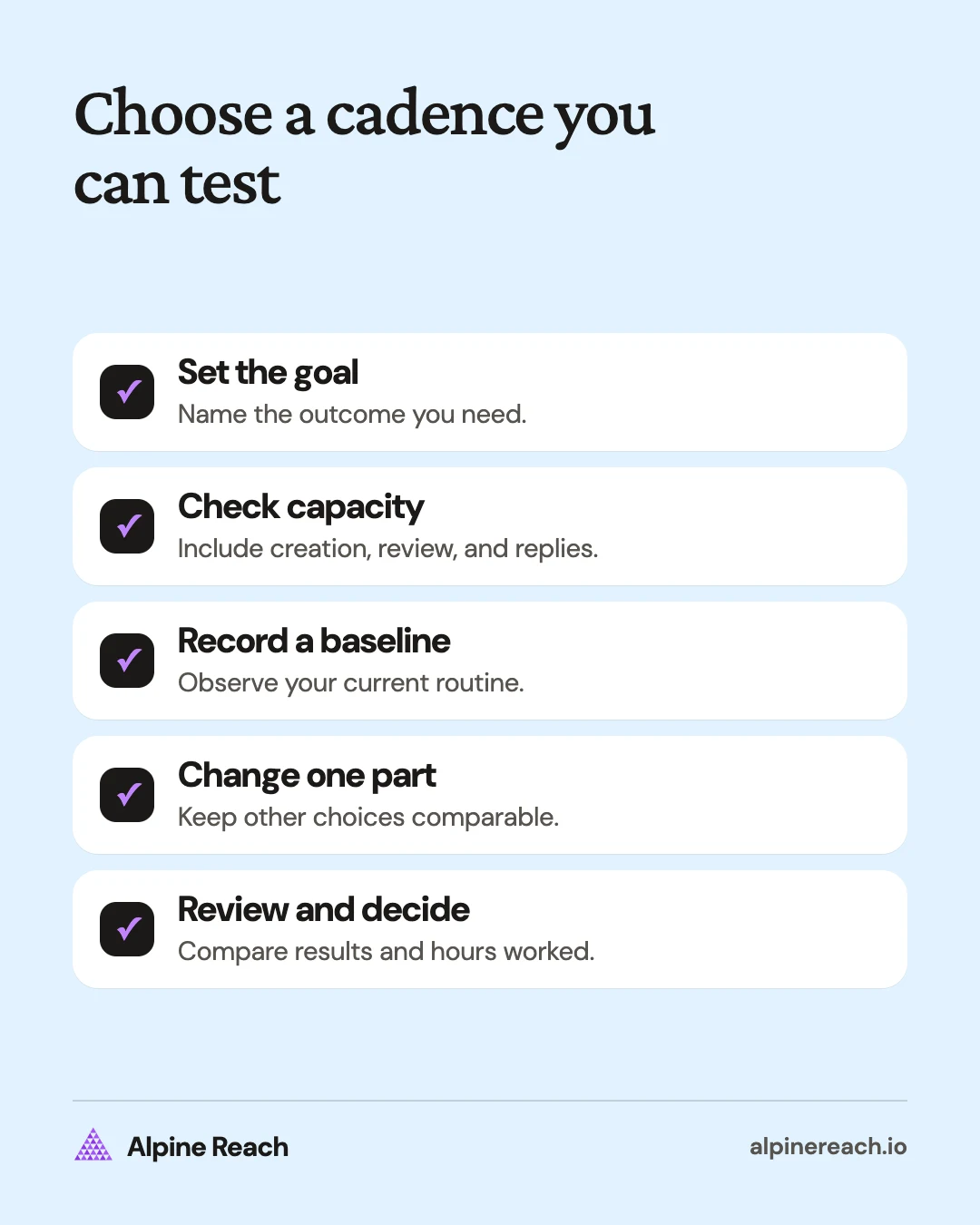
- Define the goal. Choose what you want to observe: useful questions, service interest, repeat viewing, or another outcome relevant to the account.
- Measure production time. Include preparation, creation, review, publication, and replies. Reserve time for revisions and normal interruptions.
- Set a repeatable baseline. Use a schedule you can actually deliver, then record its results before raising volume.
- Test a small change. Keep topics and formats reasonably similar, and give posts comparable time to collect results.
- Review typical and total results. More posts can change the total while individual posts perform differently. Look at both, alongside hours worked.
- Keep, adjust, or reverse. Choose the schedule that serves the goal without repeatedly exceeding your available time.
Write down changes to offers, seasons, formats, or audience size during the test. With little data, the honest conclusion may be that you need more comparable observations. A short test can establish whether the workload is feasible before it establishes whether performance improved.
Put the chosen slots into your social media content calendar. At the next review, change the frequency because of evidence about your audience or capacity, and record why you changed it.
FAQ
Does reposting an idea on another platform count as one post?
For workload planning, count each platform version separately. Each still needs its own review, publishing check, and measurement, even when the core idea is shared.
Should I catch up after missing a planned day?
Check whether the content is still relevant and ready. Reschedule useful work at a manageable pace instead of adding a rush of posts only to restore the original count.
What if I cannot sustain a study’s suggested posting range?
Choose a lower workload you can deliver, record it as your baseline, and test changes when capacity improves. A study range is a reference for a test, not a requirement.
General information. Platform features, limits and benchmarks change: check the cited page before you rely on a number.
References
- Buffer. How Often Should You Post on Instagram in 2026? What Data From 2 Million Posts Tells Us. 2025. View source (accessed Nov 10, 2026).
- Buffer. How Often Should You Post on TikTok in 2026? Data From 11 Million+ Posts. 2025. View source (accessed Nov 10, 2026).
- Buffer. How Often Should You Post on LinkedIn in 2026? Data From 2 Million+ Posts. 2025. View source (accessed Nov 10, 2026).
- YouTube Help. Upload schedule tips. n.d. View source (accessed Nov 10, 2026).
- Meta Newsroom. Introducing Best Practices, an Education Hub for Creators on Instagram. 2024. View source (accessed Nov 10, 2026).
- TikTok Creator Academy. Grow Your Account With Our Posting Cadence Tips for All Industries. 2026. View source (accessed Nov 10, 2026).
- LinkedIn. The ultimate guide to LinkedIn Page posting. n.d. View source (accessed Nov 10, 2026).
- vidIQ. YouTube Upload Frequency Study: How Often Should You Upload? 2026. View source (accessed Nov 10, 2026).