

In short
- Connect topics, formats, responsibilities, and measurement to a goal.
- Use available audience and content data to inform your next plan.
- Campaign links can help you distinguish referring campaigns in website reporting.
In this article
- What is a content plan, and how is it different from a calendar?
- Choose a goal and describe the reader's problem
- Set the pillars, formats, and content mix
- Copy this one-page social media content plan
- Define measurement before scheduling posts
- Turn the plan into a weekly calendar and review it
- FAQ
- References
A content plan for social media sets the goal, audience, recurring topics, formats, and success measures for a month or quarter. Write those decisions on one page, check that you can produce the work, and then use a calendar to schedule the individual posts.
What is a content plan, and how is it different from a calendar?
A plan gives your posts a shared purpose. Hootsuite's content-planning guide connects topics, formats, platforms, responsibilities, and measurement to marketing goals.1
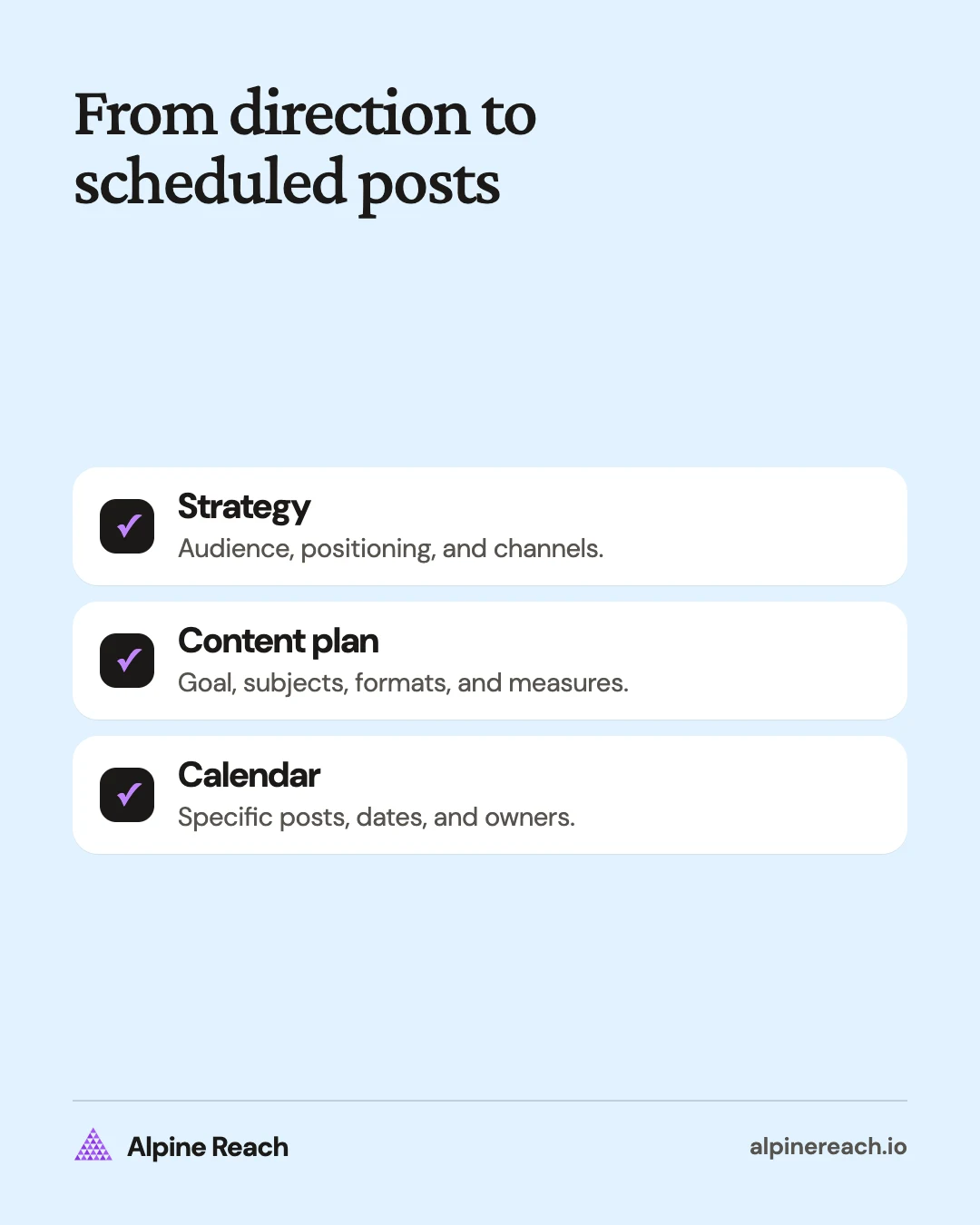
Use this distinction when you are deciding what to write:
| Document | Decision it makes | Example |
|---|---|---|
| Social media strategy | Who you serve, where you participate, and why you are worth following | Help independent retailers make informed inventory decisions |
| Content plan | What the month will cover and how you will judge it | Explain stock reviews, demonstrate a worksheet, and invite suitable inquiries |
| Content calendar | What publishes when and who finishes it | Publish the stock-review explainer on Tuesday after Monday's approval |
Terminology varies between teams. You can keep these decisions in the same document as long as everyone can find them. The useful test is whether a writer could choose the right topic without inventing the audience or goal.
If you are still choosing the audience and channels, start with how to create a social media strategy. This article covers the next decision: what your content should do during a defined planning period.
Choose a goal and describe the reader's problem
Write a goal you can observe. "Post more" describes output. "Help suitable shop owners understand the service and request a walkthrough" describes the purpose of that output. Choose a planning period so you know when to review it.
Then describe a real reader in terms of their task. "Small business owners" is a broad audience. "Independent retailers who review stock themselves and struggle to decide what to reorder" gives you a specific problem to address.
Gather questions from sources you can actually inspect: comments on your posts, support questions, inquiry emails, interviews, and the words people use when asking about your offer. Remove identifying details before using a question in a brief.
For an existing LinkedIn company Page, its analytics can provide information about visitors, followers, and content performance.2 Use that evidence alongside conversations. The people who currently follow you may differ from the people you want to reach next.
Draft an audience statement with these blanks: "You are helping [person] do [task] despite [obstacle]. Your content should make [decision or action] easier." Treat it as a working assumption and write down what would make you change it.
Set the pillars, formats, and content mix
Content pillars are recurring subjects you will return to. Choose subjects that connect the audience's questions with what you can credibly explain. "Video" is a format, not a pillar; "preparing a stock review" is a subject.
For an inventory consultant, the monthly mix could look like this:
| Pillar | Reader question | Format to try | Job in the plan |
|---|---|---|---|
| Preparation | What information should I gather before reviewing stock? | Written checklist | Help the reader start |
| Decision-making | How do I compare an item that sells slowly with one that sells out? | Annotated fictional worksheet | Explain a decision without claiming an outcome |
| Service fit | What does an inventory walkthrough cover? | Plain service explanation | Help the reader decide whether to inquire |
Allocate the mix by the work each post needs to do. For a first plan, you might assign more space to practical explanations while including a clear service post. That is a choice to test, not a universal ratio. Ratios such as 80/20 or 50/30/20 are marketers' conventions, not platform rules; write down why you chose your split so you can review it.
Make the formats realistic. If you cannot record a convincing demonstration, use an annotated example rather than listing video as a requirement. When adapting an idea for another platform, rewrite the opening and next step for that audience instead of duplicating the calendar row.
Leave room for questions that arrive during the month. Describe what qualifies for that space: a repeated audience question, a correction, or a relevant change to the offer. A flexible slot still needs a reason to exist.
Copy this one-page social media content plan
Here is a filled example. Replace the details, including the hours and post count, with your own.
| Decision | Filled example |
|---|---|
| Period | December 2026, reviewed after the month ends |
| Goal | Generate relevant conversations about an inventory walkthrough |
| Audience | Independent shop owners who handle their own stock reviews |
| Main problem | Uncertainty about what to prepare and how to interpret a stock list |
| Main channel | LinkedIn, chosen as an initial audience hypothesis |
| Core message | Understand the stock-review process before choosing outside help |
| Pillars | Preparation, decision-making, service fit |
| Formats | Text explanations, checklists, and annotated fictional worksheets |
| Planned mix | Four practical explanations, two worksheets, and two service-fit posts |
| Workload | Eight posts across the month; four hours reserved each week for production and replies |
| Owner and reviewer | Consultant drafts; a subject specialist checks technical explanations |
| Next step | Read the service scope, then request a walkthrough if appropriate |
| Primary measure | Relevant inquiries, recorded with their stated source when available |
| Supporting measures | Service-page visits and questions from intended readers |
| Baseline | Record the previous comparable period before setting a numeric target |
| Review rule | Keep useful topics; revise unclear explanations; reduce scope if production exceeds capacity |
Eight posts is the example's workload. If a worksheet takes longer than expected, reduce the volume or simplify the production before committing to the calendar. For platform guidance and dated studies on volume, see how often to post on social media. Keep the one-page plan in a shared doc and the individual posts in a spreadsheet or calendar tool your team already opens.
Keep your actual plan this short. Put research, draft copy, and creative files in linked records so the decisions remain easy to scan. If you need more pillar ideas, see content pillars and examples.
Define measurement before scheduling posts
Choose a primary measure close to the goal and a few supporting observations. For inquiries, define "relevant" before you count: the person has the problem you serve and is asking about an offer you can provide.
Keep different events separate. A reaction is not an inquiry. An inquiry is not a purchase. A website visit can help you understand interest, but it does not establish which post caused a later sale.
If you use Google Analytics, campaign parameters on destination links can identify referring campaigns in acquisition reporting.3 Decide a consistent campaign name and use distinct content labels when you want to distinguish posts. Google documents utm_content for differentiating creatives.3
Do not assume every app visit or private conversation will be attributed. Pair link data with what people tell you, and leave the source unknown when you cannot establish it. For a new account, your first plan can gather a baseline rather than invent an ambitious growth target.
Record when you will evaluate results. Compare similar formats over comparable periods after publication. A post measured immediately and another measured much later do not provide a fair comparison.
Turn the plan into a weekly calendar and review it
Choose the first specific questions to answer, write a brief for each, and assign a production deadline before the publishing date. Use the social media content calendar template to track those individual posts.
Before scheduling, ask whether each post has a clear purpose in the plan. If every row is a service pitch, you may have left the practical questions unanswered. If no row explains the offer, interested readers may still lack the information needed to act.
During a weekly check, resolve delivery issues: missing copy, unclear ownership, late review, or an outdated destination. During the period review, reconsider the plan itself: did the intended audience respond, and did the content help with the problem you selected?
Write down a decision for the next period. Keep a pillar that produced useful questions. Rewrite an explanation people misunderstood. Reconsider the channel if you cannot find evidence of the intended audience. Change the plan because of an observed problem, and record the assumption you will test next.
FAQ
Should a content plan cover a month or a quarter?
Choose a period that matches how stable your offer and priorities are. A quarter can set the direction, with a monthly plan for the subjects and workload you are ready to commit to.
Can I make a plan before I have analytics?
Yes. Start with audience questions, label channel choices as assumptions, and use the first period to record a baseline. Avoid treating an unsupported target as a forecast.
What should I remove if the plan is too much work?
Reduce channels, formats, or volume before removing necessary research and review. Keep the subjects that most directly help the audience with the chosen goal.
General information. Platform features, limits and benchmarks change: check the cited page before you rely on a number.
References
- Hootsuite. How to plan social media content in 2026: 10 steps. 2026. View source (accessed Nov 10, 2026).
- LinkedIn. LinkedIn Pages Best Practices. n.d. View source (accessed Nov 10, 2026).
- Google Analytics Help. URL builders: Collect campaign data with custom URLs. n.d. View source (accessed Nov 10, 2026).