

In short
- Use account and audience evidence to inform your channel decisions.
- Population adoption figures help with a shortlist but do not measure buying intent.
- Check production capacity and goals before choosing a schedule.
In this article
- 1. Set a business goal and record your starting point
- 2. Research the audience's questions and decisions
- 3. Choose channels using audience fit and capacity
- 4. Define positioning and a recognizable voice
- 5. Choose a content mix tied to the goal
- 6. Assign ownership and a sustainable publishing rhythm
- 7. Measure progress and choose what to change
- FAQ
- References
To create a social media strategy, decide what your business needs, who you want to help, which channels you can support, and why your content deserves their attention. Then choose a content mix, assign the work, and define how you will measure progress through the seven steps below.
1. Set a business goal and record your starting point
Choose an outcome social media can reasonably support: helping people discover your work, answering buying questions, attracting suitable inquiries, or supporting existing customers. Write the goal in ordinary language before choosing metrics. Then make it SMART: specific, measurable, achievable, relevant, and time-bound. The goal becomes measurable when you add what you will count and by when, such as relevant walkthrough requests recorded during the next quarter.
For a bookkeeping software founder, a useful goal might be "Help independent consultants understand the invoicing workflow and request a product walkthrough if it fits." This is an illustrative direction, not a promised outcome.
Audit the accounts you already have. Record who owns access, the intended audience, the offer in the profile, recent topics, and the action each profile asks visitors to take. Note which posts produced relevant questions and which received little response.
LinkedIn says company Page analytics cover visitors, followers, and content performance, including comparisons with competitors.1 Those are inputs to an audit, not proof that a channel contributes revenue.
Write down the baseline using the same period and definition you plan to use later. If you have no history, make the first period a learning period. Set a workload you can control and collect evidence before choosing a growth target.
2. Research the audience's questions and decisions
Describe the people you want to reach by the problem they are trying to solve. Add what they already understand, what makes the decision difficult, and what kind of help you can credibly provide.
For the fictional invoicing product, "freelancers" is too broad to guide a writer. "Independent consultants who send invoices themselves and lose track of what needs follow-up" suggests concrete topics and language.
Gather evidence before calling that your audience. Read questions on your own posts, review support and inquiry themes, and ask prospective users about their process. Keep a short research log with the question, where it came from, and what remains uncertain.
Use direct questions: What were you trying to do? What got confusing? What did you search for? Where did you look for help? Avoid asking people to validate a feature or topic you have already decided to promote.
Separate observations from hypotheses. "Several inquiries mention tracking unpaid invoices" is an observation if your records support it. "This audience wants daily video tips" is a hypothesis until you have evidence. Do not invent interviews or audience quotes to make a strategy document look complete.
3. Choose channels using audience fit and capacity
Make a shortlist of channels where you have evidence of the intended audience. Then ask whether you can create appropriate content and participate in the conversations there.
Population research can help with the shortlist. Pew Research Center's fact sheet published October 19, 2026 found that 84% of US adults say they ever use YouTube, 51% use Instagram, 37% use TikTok, and 31% use LinkedIn.2 The survey covered 5,511 US adults from January 30 to June 18, 2026.2 These are broad adoption figures, not the share who will see a business post or buy from it.
| Channel question | Evidence to look for | Reason to defer |
|---|---|---|
| Is the audience present? | Relevant conversations, existing followers, and audience research | Only a large headline user count supports the choice |
| Can you help in the available formats? | A useful topic you can turn into a credible post | Every idea depends on resources you do not have |
| Can you maintain it? | An owner with time to create, publish, and reply | No one can support it after launch |
| Can you observe progress? | A defined next step and a way to record responses | Nobody knows what success would mean |
Choose a main channel for the first plan. Add another when it has a specific role and an owner. A small team can make a deliberate choice to defer a channel and write down what evidence would justify adding it later.
4. Define positioning and a recognizable voice
Write why the intended audience should spend time with your content. Use a simple statement: "For [audience], we explain [problem] through [useful approach], so you can [make a decision or complete a task]."
The hypothetical invoicing founder could choose: "For independent consultants, we explain invoicing decisions with plain examples, so you can understand the workflow before choosing software." That statement helps reject broad entrepreneurship topics that do not serve the purpose.
Choose voice rules a writer can apply. For example: use ordinary terms, explain unfamiliar accounting language, show a fictional example when needed, and state limitations. Avoid unsupported claims about saving time or improving collections.
Review public alternatives to understand what readers already receive. Look for unanswered questions or a clearer way to explain the topic. Borrowing another account's opinions, stories, or distinctive wording does not establish your own position. For a fuller writing framework, use the brand voice guide.
5. Choose a content mix tied to the goal
Define content pillars, meaning recurring subjects. Then decide which posts explain a problem, demonstrate an approach, answer an objection, or clarify the offer.
For the fictional founder, pillars might include invoice preparation, payment follow-up, and software fit. Those subjects can support this mix:
| Role | Hypothetical post | Reader's next step |
|---|---|---|
| Explain | What information belongs in the invoicing workflow | Check your current process |
| Demonstrate | Walk through a fictional invoice record | Try the sample workflow |
| Clarify | What the product does and what still needs your input | Read the product details |
| Listen | Ask which part of follow-up feels confusing | Share a specific question |
Do not assign a universal percentage to each role. You will see rules of thumb such as 80/20 or 70/20/10. They are marketers' conventions, not platform rules, so treat any split as a starting assumption to test. Choose a mix you can explain in terms of your goal and the questions you found. Plan a direct offer when it helps the reader decide, and provide enough practical content for them to evaluate your approach.
Turn those choices into a monthly content plan. Keep the strategy focused on direction; keep individual dates and drafts in the calendar.
6. Assign ownership and a sustainable publishing rhythm
Name the person who drafts, checks, approves, publishes, and replies. A solo creator may own all of those steps, but each step still needs time.
YouTube's upload guidance asks creators to consider a sustainable frequency, production time, content volume, and goals when building a schedule.3 Apply that capacity check before selecting a rhythm for any channel.
Write a fallback rule for busy weeks. You might pause a complex demonstration and publish an already checked explanation instead. Keep a current offer or time-sensitive announcement out of the queue until someone verifies it.
Document how you will handle questions and corrections. Decide who can answer a product question, when to request specialist review, and how to pause a post if the information changes. Those operational decisions belong in the strategy because they determine whether the plan is feasible.
Use the content calendar guide for the publishing workflow and posting frequency evidence for platform-specific research.
7. Measure progress and choose what to change
Choose a main measure connected to the goal and supporting measures that help explain it. For relevant inquiries, record the inquiry and its fit. For useful explanations, record audience questions and responses. Reach usually means how many distinct accounts saw your content, while counts of total displays can include repeat views. Each platform names and defines these metrics in its own analytics help, so check the definition before comparing two apps.
For website traffic, Google Analytics documents campaign parameters that let you identify referring campaigns in acquisition reporting.4 Use consistent names for the channel and campaign when you share trackable links. Do not treat a tagged visit as proof that the post caused a later purchase.
Set a review date before publishing begins. Inspect whether the content reached the intended people, whether the next step was clear, and whether the workload held up. Use comparable measurement periods and keep exceptional posts separate from a typical result.
Finish the review with a decision: keep a useful subject, revise a confusing explanation, reduce an unsustainable workload, or reconsider a channel with little evidence of audience fit. Record the reason and the next question to test. Your strategy is usable when the team can make those choices without guessing what the business wanted.
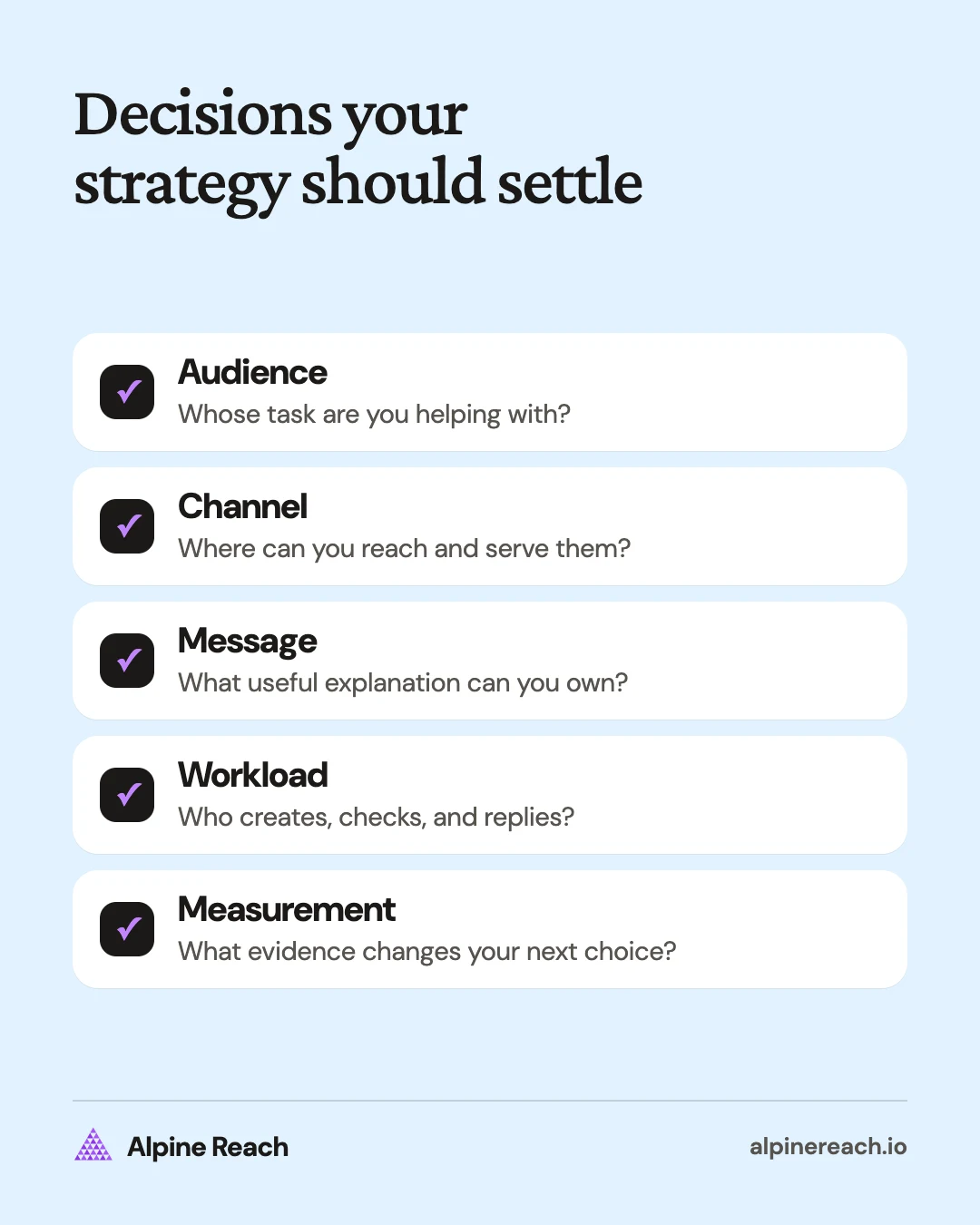
Put the strategy on one page
| Decision | Your answer |
|---|---|
| Business goal | |
| Starting point (accounts, owners, baseline period) | |
| Audience (person, task, obstacle) | |
| Main channel and evidence | |
| Positioning statement | |
| Pillars and post roles | |
| Owners and weekly workload | |
| Main measure, supporting measures, review date |
FAQ
Can a solo founder use this strategy process?
Yes. Keep the decisions in a short document and choose a workload you can own. The writing, checking, publishing, and reply responsibilities still need time, even when one person handles them.
When should I reconsider my main channel?
Review it when your evidence suggests the intended audience is absent, the workload is unsustainable, or the channel is not supporting the goal. Record what you learned before switching.
How is a social media strategy different from a campaign?
The strategy sets the ongoing audience, message, channel choices, and measures. A campaign gives a defined initiative its own content, timing, and next step within that direction.
General information. Platform features, limits and benchmarks change: check the cited page before you rely on a number.
References
- LinkedIn. LinkedIn Pages Best Practices. n.d. View source (accessed Nov 10, 2026).
- Pew Research Center. Americans’ Use of Social Media in 2026. 2026. View source (accessed Nov 10, 2026).
- YouTube Help. Upload schedule tips. n.d. View source (accessed Nov 10, 2026).
- Google Analytics Help. URL builders: Collect campaign data with custom URLs. n.d. View source (accessed Nov 10, 2026).