

In short
- Record the period and net follower change before deciding what to repeat.
- Compare content-attributed follows at a consistent age, and keep unavailable data separate from zero.
- Check which audience and metric a demographic or exposure breakdown describes.
- Finish with one content change and a measure to review next month.
In this article
- Start with follower growth over a defined period
- Find the content associated with new follows
- Read who follows you without assuming their interests
- Compare follower and non-follower exposure carefully
- Read the follower list for context
- Keep login details out of follower trackers
- Finish your monthly review with one decision
- FAQ
- References
Analyze your Instagram followers by comparing audience growth, content-attributed follows, audience details, and exposure to followers versus non-followers over a consistent period. Then choose one content change to test next month, treating your explanation of the pattern as a working guess.
Start with follower growth over a defined period
Choose a calendar month and record its dates, your capture date, and the follower totals at the start and end. As of November 2026, Instagram documents growth under Total followers as followers gained or lost, with follower trends available once you have at least 100 followers.1
For access instructions and the broader metric list, use the Instagram Insights guide. Here, the question is what to change after reading your audience data.
Subtract the starting total from the ending total to calculate net change. If your screen also separates Follows and Unfollows, record both for the same dates. Instagram's help page confirms growth, but does not promise that exact pair of labels for every account.1 Leave an unavailable breakdown blank rather than guessing it from net change.
Consider this made-up ceramic shop account. All its figures below are example numbers for an October review:
- Starting followers: 1,200.
- Ending followers: 1,260.
- Net change: 1,260 minus 1,200 equals 60.
- Example breakdown, if available: 100 follows minus 40 unfollows equals 60.
The net increase is 60, not 100. The breakdown would prompt a different question from the total alone: what attracted the new follows, and what else changed during the month? A loss total does not explain why anyone left. Note changes in topics, offers, posting volume, or paid promotion before forming a guess to test.
Save a monthly record of your observations for later comparisons.
Find the content associated with new follows
Review individual content before deciding which subject deserves another attempt. As of November 2026, Instagram explicitly defines Follows for a Reel as accounts that started following you as a result of viewing that Reel.2 This is a more specific result than noting that your follower total increased on publication day.
For the shop example, suppose a mug-care Reel records 24 follows and a studio-tour Reel records 6, each captured seven days after publication. Both were unpaid posts. The care Reel is a candidate to revisit. A working guess is that practical care advice gives viewers a reason to return; test another care question next month before treating that explanation as established.
Record the topic, format, publication date, capture date, and available follow count. Compare similar formats after the same amount of time. If one item had paid support, keep that context visible.
Instagram's feed-post help page does not separately define a Follows metric.3 Use a clearly labeled follow count if your post's own insights provide one. Mark missing follow data as unavailable. For the distinction between Profile activity and individual actions, see the profile visits guide.
Compare the month's net change alongside content-attributed follows, without expecting selected posts to explain the whole result.
Read who follows you without assuming their interests
Use audience details to check whether your examples and practical information fit the people you want to serve. As of November 2026, Instagram lists top locations, age range, and most active times under Total followers, subject to the 100-follower threshold.1
For the shop, a prominent local audience might suggest testing a pickup explanation. A geographically spread audience might suggest a shipping explanation. These are guesses about useful questions, not conclusions that a location reveals someone's buying plans.
Read active times as a possible publishing window to test. Keep the content topic comparable when you test timing, and evaluate whether that window helps your own posts.
Check which audience the demographics describe. Instagram separately documents location, age, and gender breakdowns for viewers and accounts engaged.1 Those require preset timeframes and more than 100 accounts reached or engaged, respectively.1
Gender is not separately listed in that help page's Total followers bullets.1 Meta's Business Suite documentation does include gender in its Audience tab, alongside age and location, and requires permission to view the relevant Instagram profile's insights.4 If you use that view, check whether the audience label describes your current or potential audience before using its figures.
Age and gender alone are poor reasons to assign people an interest. Combine the available audience description with actual questions readers ask, then choose a topic you can test. The Instagram content ideas guide can help turn that question into a post.
Compare follower and non-follower exposure carefully
Look for exposure beyond your current followers. As of November 2026, Instagram defines Viewers as unique accounts that saw content on screen at least once.1 Meta documents follower and non-follower breakdowns for Views and Content interactions in Business Suite's content overview.4
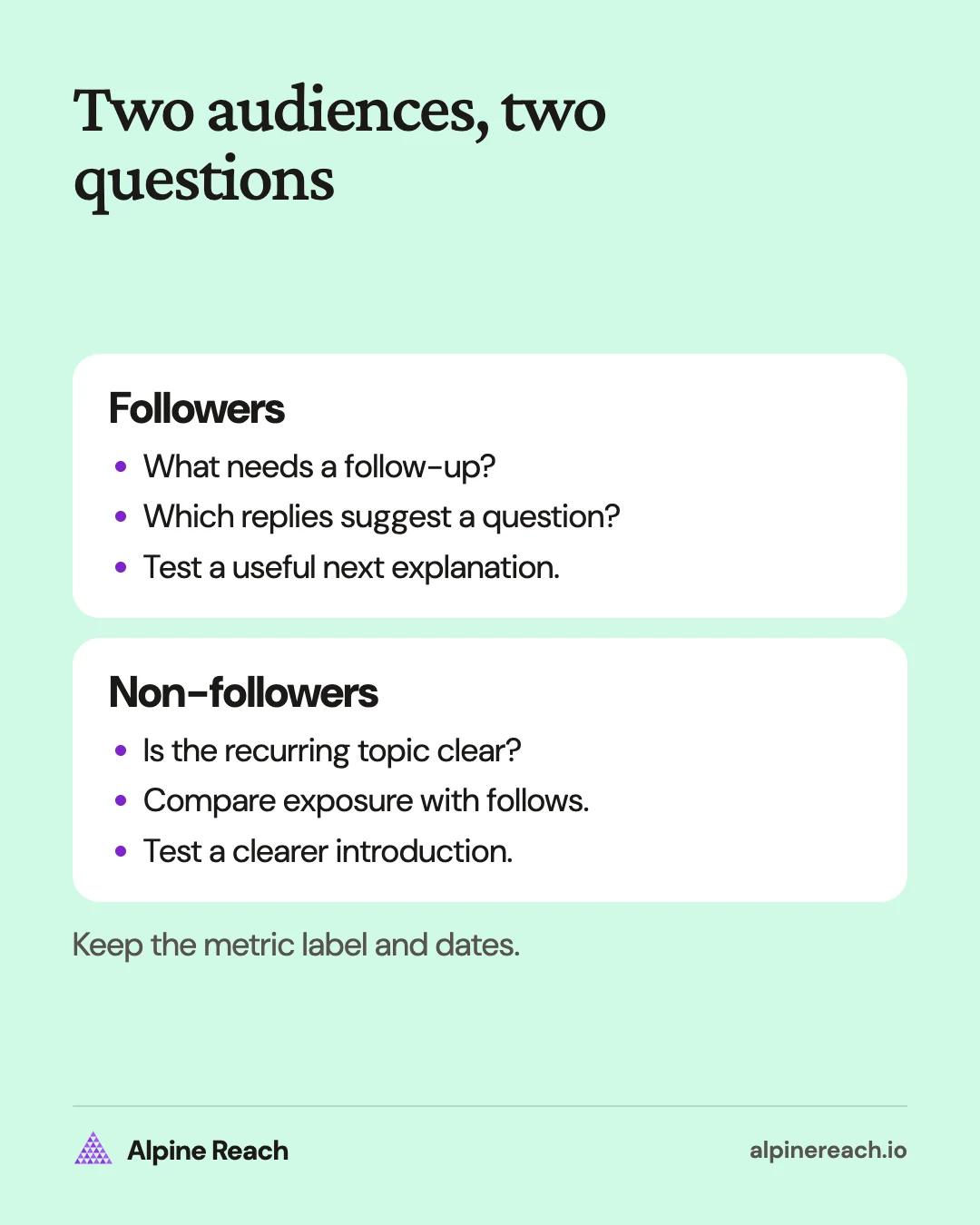
Record the breakdown with its metric and dates. Use reach or unique viewers only if the report explicitly labels those measures. A views breakdown describes plays or displays.4 Leave it labeled as views.
For the shop example, suppose a report explicitly labels a Reel's reach as 800 follower accounts and 1,200 non-follower accounts. The example total is 2,000 accounts, with 60% outside the follower audience. That describes exposure beyond existing followers; it does not say that those accounts followed afterward.
If the percentage changes, inspect both absolute counts before deciding which audience increased or decreased. Choose a follow-up for existing readers or an introduction for newcomers according to the post's purpose. There is no target split in this method.
Read the follower list for context
Review a small selection of profiles alongside aggregate data. Read only what people choose to share publicly, and avoid assigning an occupation, location, or customer status from a username or photo.
As of November 2026, Instagram documents Flagged for review in Followers when it identifies potentially spam, bot, or irrelevant accounts.5 Incoming follows from flagged accounts appear as requests in the Flagged folder.5 Instagram also warns that the feature may not be available to everyone yet.5 Review individual accounts before deciding how to handle a flag.
For content planning, note questions suggested by public profile descriptions, then check whether similar questions occur in comments or replies. Use those questions to inform a test alongside your aggregate data.
Keep login details out of follower trackers
As of November 2026, Instagram warns that apps offering likes or followers in exchange for login information can gain complete account access, including messages, and may post harmful content.6 It advises changing your password if you shared it and allows you to remove connected apps.6 Do not give an analysis app your Instagram password to complete this routine.
Finish your monthly review with one decision
Use the sequence below to review the month, then write one decision with a measure and a next review date.
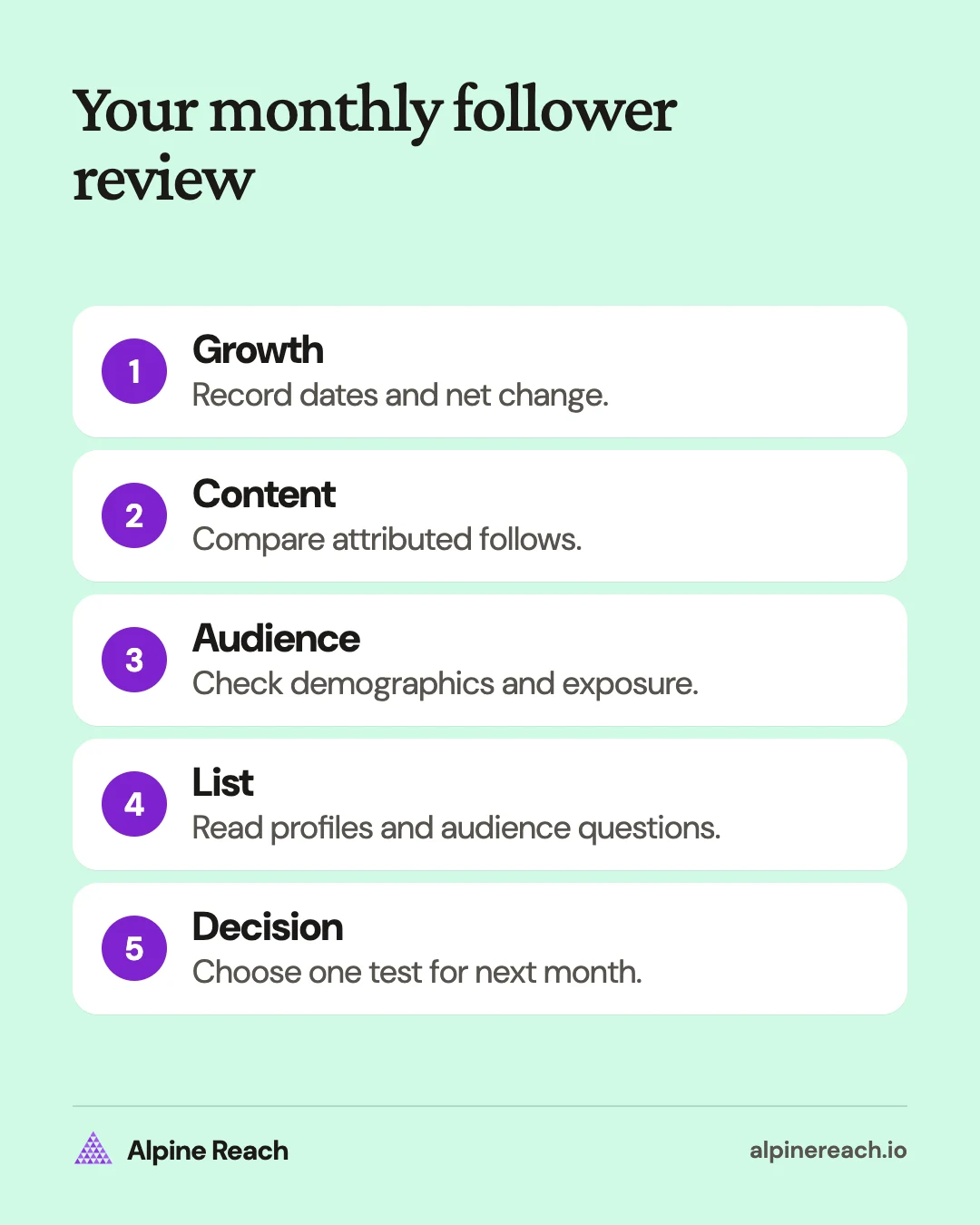
For the ceramic shop, the final decision is: “Next month, publish another mug-care Reel in the same format and compare its attributed follows after seven days with the original's 24.” The working guess is that care questions give people a reason to follow. Revisit that guess at the next monthly review, including a result that does not support it.
FAQ
What should I record when an audience breakdown is missing?
Mark it as unavailable and continue with the follower totals, content results, and audience questions you can inspect. Preserve the audience and metric labels for the data you use.
Should I stop posting a topic after one weak month?
Review comparable content and note changes in format, paid support, and posting volume. Treat your explanation as a guess, then choose a focused test before replacing the topic.
How do I choose between attracting new followers and helping current ones?
Set the purpose of the next post first. Test an introduction for newcomers or a follow-up to existing readers, then evaluate that post against its intended purpose.
General information. Platform features, limits and benchmarks change: check the cited page before you rely on a number.
References
- Instagram. About Instagram insights. n.d. View source (accessed Nov 16, 2026).
- Instagram. View insights on your Instagram reels. n.d. View source (accessed Nov 16, 2026).
- Instagram. View insights on your Instagram posts. n.d. View source (accessed Nov 16, 2026).
- Meta. About Insights in Meta Business Suite on desktop. n.d. View source (accessed Nov 16, 2026).
- Instagram. Manage unwanted followers on Instagram. n.d. View source (accessed Nov 16, 2026).
- Instagram. Why you should not use apps that offer likes and followers on Instagram. n.d. View source (accessed Nov 16, 2026).