

In short
- Open with the guide's users, audience, scope, and a short voice summary.
- Give each trait a boundary and rewrite, then record vocabulary and mechanics.
- Add situation-specific examples and name an owner for updates and writer handoffs.
In this article
- 1. Open with the reader, scope, and voice summary
- 2. Turn voice traits into editing instructions
- 3. Make a short use-and-avoid vocabulary list
- 4. Add tone notes for channels and situations
- 5. Write down formatting and grammar choices
- 6. Save complete before-and-after rewrites
- 7. Keep the guide short, owned, and ready to hand off
- FAQ
- References
Write a brand voice guide by putting your writing decisions in a short, shared document: audience, voice summary, traits, vocabulary, tone examples, mechanics, and approved rewrites. Give each rule a sentence someone could actually publish, then name who maintains the guide and how writers should use it.
Cedar Clay, a made-up pottery studio offering beginner classes, is the example throughout. If you still need to choose your voice, start with the brand voice explanation and chart. Here, the job is to turn those decisions into a document someone can open while drafting.
1. Open with the reader, scope, and voice summary
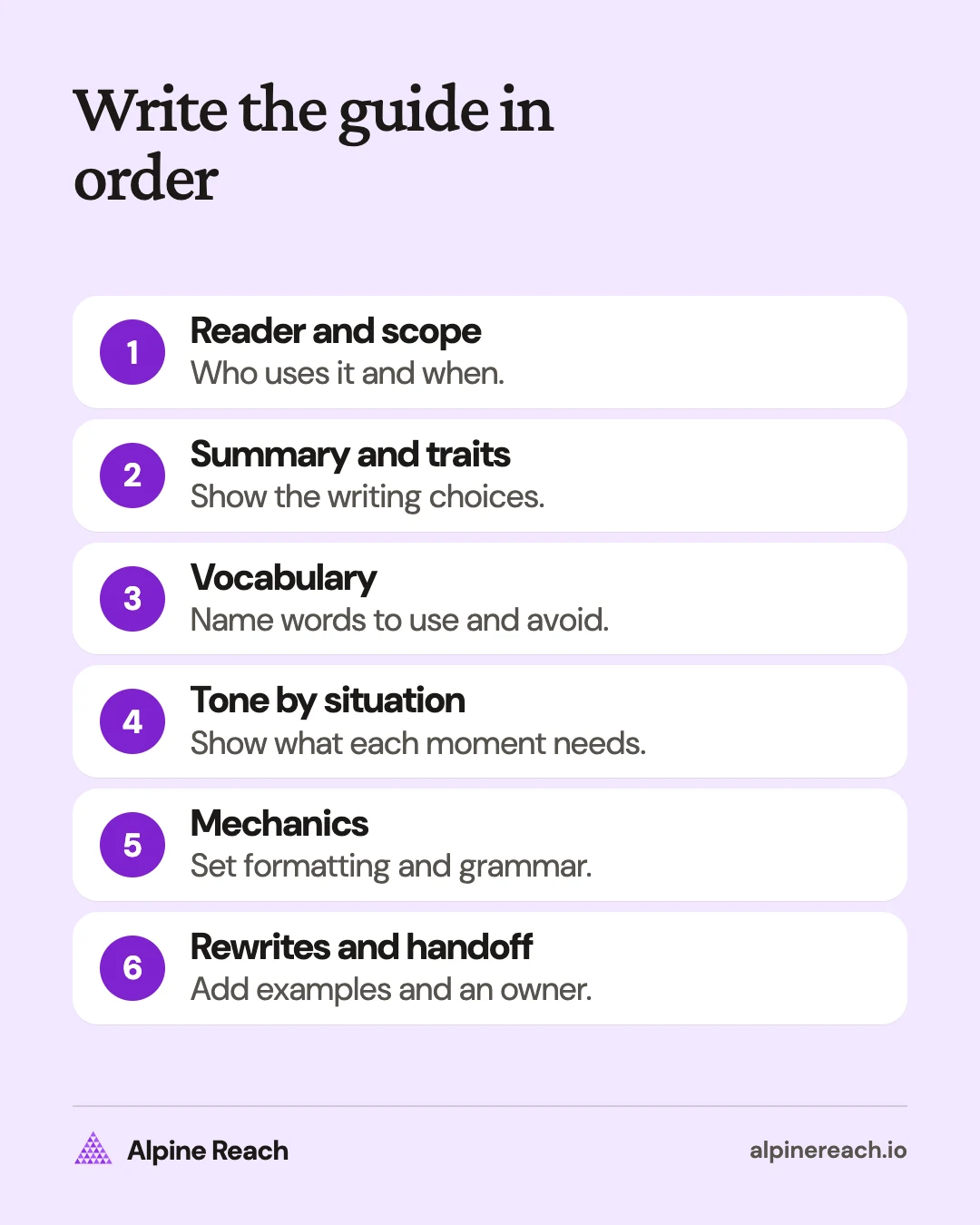
Start the document with who it serves and when to consult it. Then arrange the remaining sections in the order a writer needs them: voice summary and traits, vocabulary, tone by situation, mechanics, and rewrites with handoff instructions.
Distinguish the guide's users from the audience they write for. For Cedar Clay, record:
- Users: The studio owner, class coordinator, and freelance writer.
- Audience: Adults considering a first pottery class, including people worried about their lack of experience.
- Scope: Studio social posts, class descriptions, booking emails, and public replies. Personal instructor accounts have their own voice.
- When to open it: Before a first draft, during an edit, or when a reply involves a complaint or disappointing news.
Follow that block with a paragraph a writer can read before starting:
“Write as a patient instructor explaining what happens in a beginner class. Use ordinary words and concrete descriptions. Welcome questions without making the reader feel behind. Be honest about what a class includes and what still takes practice. Keep jokes away from complaints and cancellations.”
This is the working summary, so resist adding the company's entire history. If a sentence does not help someone choose words, move it elsewhere.
2. Turn voice traits into editing instructions
Give each trait a boundary and a rewrite. Microsoft's published guide turns its voice into instructions such as “Get to the point fast.”1 Use that level of specificity when explaining how your own traits affect a sentence.
Patient, not patronizing
Rule: Explain what a newcomer needs without calling it obvious or easy. Avoid language that judges how quickly someone learns.
Before: “It's easy to follow along, even if you've never touched clay.”
After: “You can follow along without previous experience with clay.”
The revision keeps the invitation to beginners and removes the judgment about difficulty. Add a note that “patient” also applies when someone asks a question already answered on the booking page.
Specific, not abrupt
Rule: Name the action or item the reader needs, with enough context to act.
Before: “Please arrive suitably prepared for your session.”
After: “Wear clothes you don't mind getting clay on.”
The second sentence spells out what preparation means. Put it in the guide only if that clothing instruction is accurate for your business.
Candid, not discouraging
Rule: State a limitation plainly, then explain the available option.
Before: “Unfortunately, we are unable to accommodate requests to choose a firing date.”
After: “You can't choose a firing date. Ask us which collection dates are available.”
Both versions keep the limit. The rewrite adds a useful question, so its approval depends on the studio actually being able to answer it. That check belongs beside the example.
Keep each trait because it changes an edit. If two traits lead to the same instruction, combine them instead of asking a freelancer to distinguish nearly identical labels.
3. Make a short use-and-avoid vocabulary list
Record recurring wording decisions, especially terms for your offer and the people using it. Include a replacement and a reason beside each phrase you want writers to avoid.
For Cedar Clay, the vocabulary section might read:
- Use “beginner class.” Avoid “creative journey” when naming the offer. Readers need to know what they are booking.
- Use “students” or “you.” Avoid “clay family.” Warmth does not require assuming a personal relationship.
- Use “practice.” Avoid “master pottery” in a class description. Describe what students will do without overstating the outcome.
- Explain “firing” on first use. Write “firing, the kiln heating process,” before using the shorter term later.
Separate terminology from taste. A product name needs consistent spelling. A tired opening may simply need a fresh sentence. Ban a phrase only when you can explain what should replace it.
4. Add tone notes for channels and situations
Write situation notes that tell a writer what to change: energy, humor, detail, and the opening sentence. Mailchimp's own guide advises writers to “consider the reader’s state of mind.”2 Use the brand voice vs tone comparison if you need to separate the shared rules from these moment-specific choices.
Use the tone of voice examples to choose wording, then save the examples that fit your business in the guide. Beside each one, record its channel, situation, allowed tone, required facts, and who approves commitments.
For Cedar Clay, cover a class launch, a complaint reply, and an unexpected closure. Specify whether each example belongs in a public caption or reply, or a private booking email. Name who confirms class details and remedies, and who carries out any promised follow-up. Keep reservation details out of public replies.
5. Write down formatting and grammar choices
Put mechanical choices in their own section so an editor can find them without interpreting a personality trait. Mailchimp's Grammar and Mechanics guide makes rules explicit, including “Use active voice.”3 Choose a manageable house style for your own writing.
Cedar Clay's starting rules could be:
- Capitalization: Use sentence case for headings. Keep official class names spelled consistently. Avoid all caps for emphasis.
- Grammar: Use US spelling, contractions, and the serial comma. Prefer “we'll email you” to “an email will be sent.”
- Emoji: Optional in routine social posts. Omit them from complaints and closure notices. Keep the full message understandable without them.
- Hashtags: Use only relevant labels on social posts. Leave them out of service emails and sensitive notices.
- Numbers: Use numerals for dates, times, and class sizes. Include the time zone for online events. Write out a number at the beginning of a sentence or rephrase it.
These are proposed editorial choices, not platform requirements. Add an exception only when an actual writing task needs one.
6. Save complete before-and-after rewrites
Include a few full messages alongside the short trait examples. A writer should be able to see how an opening, explanation, and action work together without assembling them from separate rules.
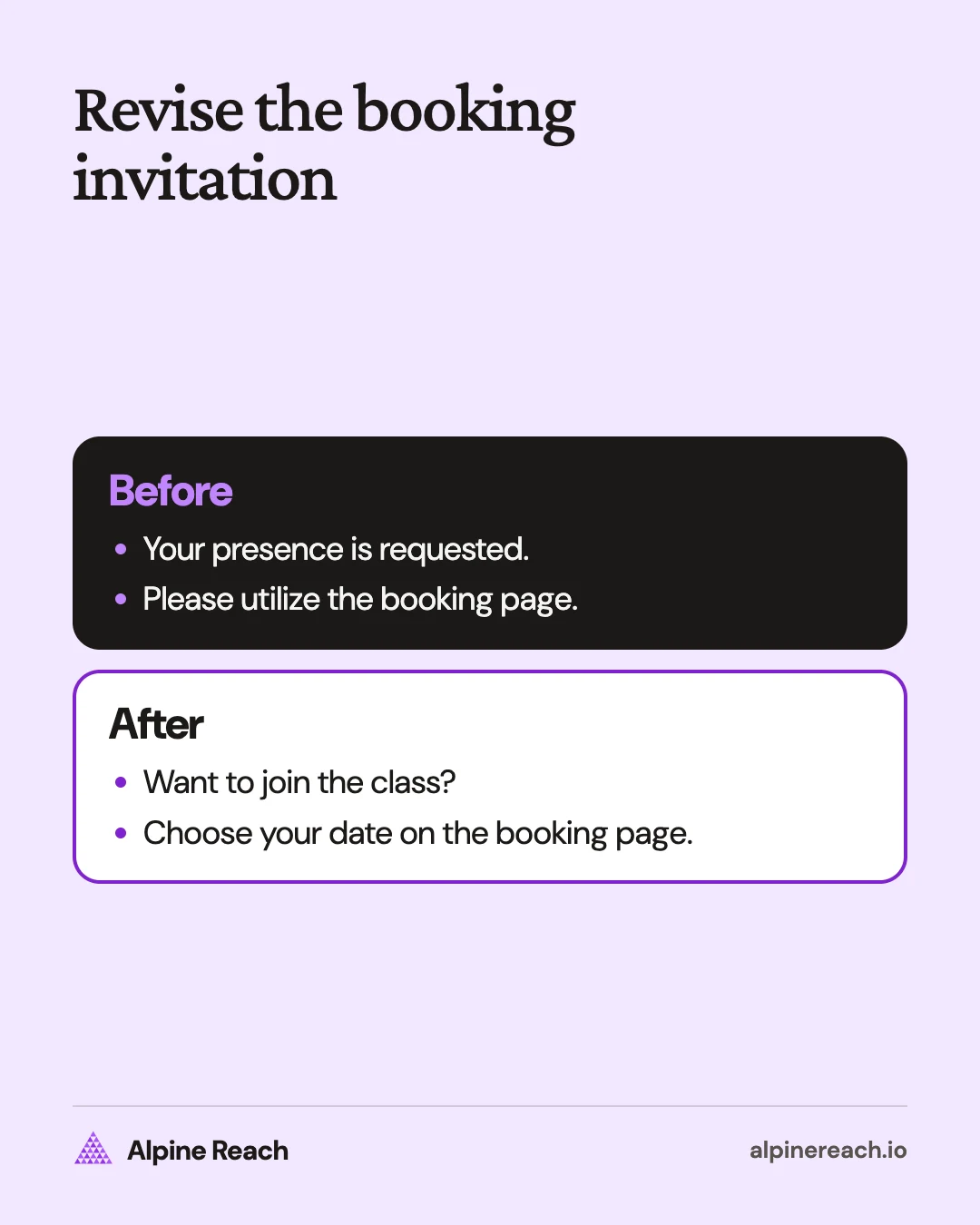
Booking invitation, before: “Your presence is requested. Please utilize the booking page.”
After: “Want to join the class? Choose your date on the booking page.”
Why: The opening becomes a natural invitation, and the next sentence names the action. The destination stays the same.
Label each example with its situation and the rule it demonstrates. Include a date and an approval note when saving real business copy. Check the facts separately from whether the sentences sound right.
7. Keep the guide short, owned, and ready to hand off
Store one current version in the shared place where you already brief writers. Link it from each assignment. Put the owner, last update, and next review date at the top, and archive older versions where nobody will mistake them for current instructions.
Keep the opening summary and recurring rules easy to scan. Put extra examples in a linked appendix. Remove repeated advice and any rule that cannot be explained with a writing choice.
If you work alone, own the updates yourself. In a small team, name one editor to approve changes and let others suggest them. Review the guide before briefing a new collaborator, when your audience or offer changes, or when the same correction keeps appearing. Use the scheduled review to check whether the examples still match the work.
For a freelancer, send the guide with the assignment, confirmed facts, an approved sample, and the person who signs off. Ask for a short draft first. Return edits with the rule that explains them, then add a useful new example to the guide.
For an AI assistant, supply the relevant rules and approved examples with the task. Keep the verified facts separate from style instructions. Add: “Preserve the supplied facts. Flag missing information. Do not invent class details, policies, promises, or personal experience.” Use the AI content workflow for the subsequent edit and fact check.
Treat a disagreement as a specific editing question. Compare the sentence with the rule and the reader's needs, then have the owner record the decision. That is the update to keep, rather than another adjective nobody knows how to apply.
FAQ
Does a solo creator need a separate brand voice document?
Start with a short document you can consult while drafting. Maintain it yourself and link it from assignments when you begin working with a collaborator.
How long should a brand voice guide be?
Keep the summary and recurring rules easy to scan while writing. Move extra examples to a linked appendix and cut advice that does not help someone make an editing choice.
What should I send a freelance writer with the guide?
Include the assignment, confirmed facts, an approved sample, and the person who signs off. Ask for a short draft first and explain edits through the guide's rules.
When should we update our brand voice guidelines?
Review them before a new collaborator starts, when your audience or offer changes, or when the same correction keeps appearing. Record the next review date in the document.
General information. Platform features, limits and benchmarks change: check the cited page before you rely on a number.
References
- Microsoft. Microsoft's brand voice: Above all, simple and human. 2022. View source (accessed Nov 14, 2026).
- Mailchimp. Voice and Tone. n.d. View source (accessed Nov 14, 2026).
- Mailchimp. Grammar and Mechanics. n.d. View source (accessed Nov 14, 2026).