

In short
- Brain Traffic's revised quad connects editorial strategy, experience design, content structure, and process design.
- Google's older YouTube playbook distinguishes help, hub, and hero: ongoing answers, recurring content, and broad promotional moments.
- Jobs-to-be-done examines the progress people seek in particular circumstances, including functional, social, and emotional dimensions.
In this article
A content strategy framework organizes decisions about what content you make, whom it serves, and why, including responsibility for keeping it useful.1 A social media strategy applies that direction to social channels and execution; a content plan and calendar specify the work and when it ships. Choose a model according to the decision you need to make: which audience problem to address, which content roles to support, or how to organize the whole operation.
Brain Traffic's quad: connect content and operations
Brain Traffic's revised content strategy quad connects editorial strategy and experience design with content structure and process design, covering both audience needs and the systems that support the content.1
The questions below adapt Brain Traffic's four areas for a small content operation:1
- Editorial strategy: What is your mission, audience, point of view, and voice?
- Experience design: What does the audience need, and how will they encounter the content?
- Content structure: How will you organize, categorize, and reuse it?
- Process design: Who owns it, checks its quality, maintains it, and can reject it?
Use this model when a freelancer and client need a shared agreement, or a small team needs content to stay coherent across a website, newsletter, and social accounts. Put a short answer under each area before discussing individual posts. For the detailed writing decisions, link your answers to a brand voice guide.
Its limit: you still need evidence to fill in the answers. As a solo creator, keep them brief and expand only where a real problem needs attention.
Hero, hub, help: give content different roles
Google introduced its YouTube Creator Playbook for Brands in March 2014.2 The linked playbook describes help, hub, and hero as complementary content types: help answers ongoing searches, hub returns regularly to audience interests, and hero supports a broad promotional moment.3 Use these roles to decide what each piece should do, then choose its subject separately.
Use these planning questions to apply those roles:
- Help: Which question deserves an answer people can find again?
- Hub: Which subject could sustain a recognizable recurring series?
- Hero: Which occasion deserves a larger standalone production?
Use this model for a creator with an existing series, a freelancer proposing a client's content mix, or a small team deciding what deserves extra production effort. Keep recurring subjects separate from these roles: content pillar examples can help you name those subjects without rebuilding your strategy.
Its limit: the playbook addresses branded YouTube content within a wider content plan.3 Treat its roles as an older planning model when adapting them to a newsletter or website. With limited time, defer hero production until there is a clear occasion and enough capacity.
Jobs-to-be-done: start with the progress people want
The Christensen Institute describes jobs-to-be-done as understanding the progress people seek in particular circumstances, including functional, social, and emotional dimensions.4 In plain terms, ask what someone is trying to accomplish, how they want to feel, and what matters in their relationships with others.
For content planning, Content Marketing Institute reports Ali Wert's application: identify what the person wants to accomplish and the reason it matters to them.5 Use that exercise to clarify audience motivation before you commit to topics or formats.
Try these questions as a content exercise:
- What situation makes the person look for help now?
- What practical progress are they trying to make?
- What worry or social concern makes that progress difficult?
- Which explanation could help them make the next decision?
Start here as a solo creator with only a few hours a week, especially when your idea list is broad but none of the ideas has a clear purpose. For a freelancer, use the exercise before accepting a client's request to write about an entire industry. For a team, use it to question whether a proposed series serves a recognizable need.
Its limit: writing a convincing sentence does not establish what your audience needs. Treat your answer as a hypothesis until you can connect it to real conversations or observed decisions. The Institute emphasizes discovering people's circumstances and stories.4 Do that work before treating a guessed motivation as a research finding.
How to choose a content strategy framework
Start with the smallest model that settles the decision currently stopping your work. These recommendations depend on your workload and responsibilities; you can add another model when a specific unanswered question justifies it.
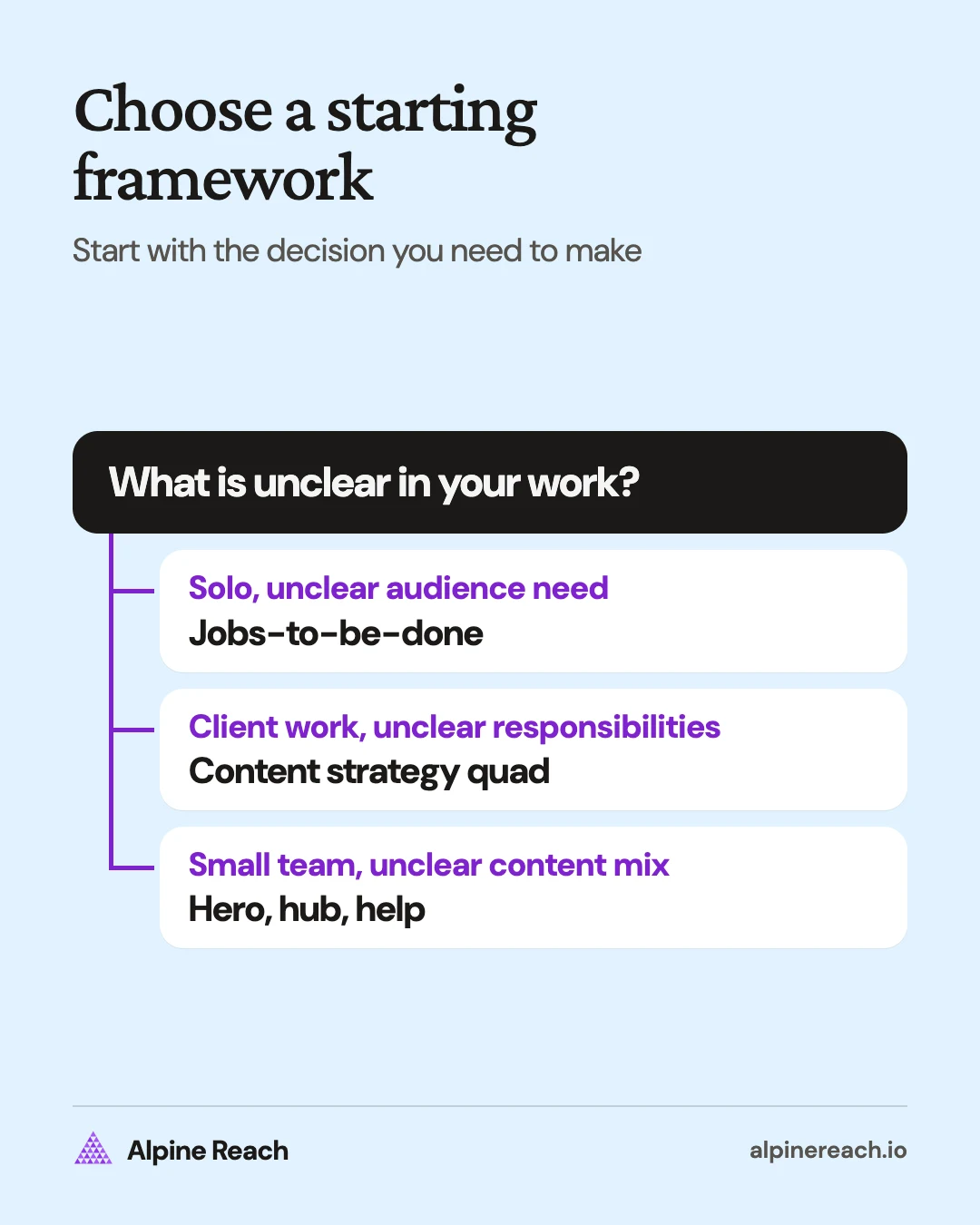
If you are working alone, test your framework on the next proposed idea. Can you explain why that piece belongs? Keep the answer visible while drafting, and stop expanding the document once it helps you make that choice.
For client work, use the framework to expose disagreements before drafting begins. Ask the client to resolve a conflict between an educational purpose and an exclusively promotional brief. Write the agreed boundary into the existing content brief so it remains easy to find.
For a team, name what is missing: the audience question or the person who can approve the answer. Resolve that issue before requesting more ideas.
A content strategy framework example on one page
This made-up account belongs to a freelance podcast editor who publishes a website, newsletter, and social posts for first-time interview hosts. Here is an application of Brain Traffic's revised quad, using its four areas as the headings.1
| Area | Filled decision |
|---|---|
| Editorial strategy | Help first-time interview hosts understand editing choices before they hand over a recording. Explain tradeoffs plainly; avoid promising a professional sound from every recording. |
| Experience design | Let a host move from a short explanation to a detailed editing example, then to the service scope if they need outside help. Keep the essential answer in each piece. |
| Content structure | Group explanations by recording preparation, editing decisions, and handoff. Give each detailed example a stable title and link shorter versions back to it. |
| Process design | The editor drafts, checks audio claims against the demonstration, and approves publication. Keep a record of source recordings and permissions. Review an explanation when the editing method changes. |
Now test a proposed piece: an annotated recording that shows which pauses the editor keeps and removes. It fits the editorial purpose, offers a detailed experience, belongs under editing decisions, and has a named person to check it.
A proposed roundup of unrelated creator trends would need a stronger reason to belong. The framework lets the editor decline it without filling a calendar first. It also reveals a production gap: if there is no recording they have permission to share, the demonstration needs a purpose-made recording before it can proceed.
Put dates, publishing slots, and the number of pieces in the later plan.
Make one decision before planning more posts
Choose your next content idea and use one framework to decide whether it belongs. Record the reason and any audience assumption you need to check, then move the accepted idea into your content plan.
FAQ
What is content strategy in marketing?
It sets the direction for what you make, whom you help, and why. In practice, include responsibility for keeping that content useful as well as the audience-facing choices.
What is an example of a strategic framework for content?
Brain Traffic's revised quad is one example. It connects editorial strategy and experience design with content structure and process design, so your content choices and operating responsibilities can be considered together.
Do I need to use all three content strategy frameworks?
Start with the model that resolves your current uncertainty. Add another only when a specific unanswered question justifies the extra work.
General information. Platform features, limits and benchmarks change: check the cited page before you rely on a number.
References
- Brain Traffic. New Thinking: Brain Traffic’s Content Strategy Quad. n.d. View source (accessed Nov 17, 2026).
- Google Partners Blog. Introducing the YouTube Creator Playbook for Brands. 2014. View source (accessed Nov 17, 2026).
- Google. Creator Playbook for Brands. n.d. View source (accessed Nov 17, 2026).
- Christensen Institute. Jobs to Be Done Theory. n.d. View source (accessed Nov 17, 2026).
- Content Marketing Institute. 5 Strategic Frameworks To Take the Guesswork Out of Content Planning. 2023. View source (accessed Nov 17, 2026).